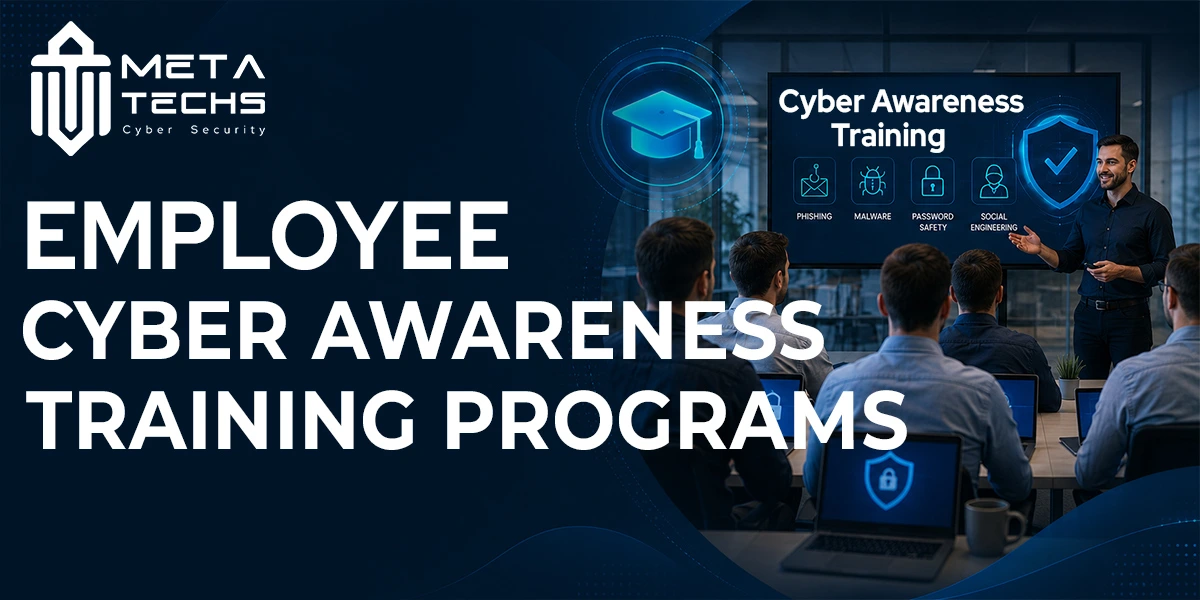
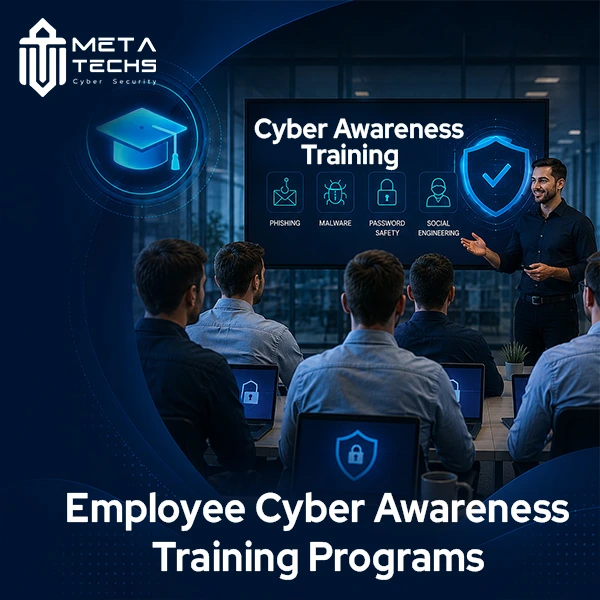
Employee cyber awareness training programs help organizations reduce the risks associated with everyday security decisions. But an effective program is not simply an annual presentation followed by a completion report. It should help employees recognize threats, make safer decisions, and know how to respond when something looks suspicious.
For enterprises, the most useful approach combines security awareness training, practical examples, phishing simulations where appropriate, and regular reinforcement. The aim is not to eliminate human involvement from security. It is to make everyday decisions less likely to create an incident.
A well-designed program should help employees:
- Recognize phishing, social engineering, and other common threats.
- Handle passwords, MFA, devices, and business information safely.
- Report suspicious activity through a clear process.
- Apply what they learn in realistic situations.
- Improve over time through relevant training and measurement.
Strengthen your workforce security — Explore Meta Techs Cyber Awareness Training
Why Human Error Is One of the Biggest Security Risks
Security incidents often involve an ordinary decision made under pressure. An employee might open an unexpected attachment, approve an unfamiliar login request, share sensitive information with the wrong recipient, or trust a message that appears to come from a senior executive.
However, describing every incident as “human error” oversimplifies the problem. Employees may be working with unclear procedures, excessive access, confusing security controls, or instructions that do not reflect how their jobs actually work. A strong awareness program should address those conditions rather than simply tell employees to be more careful.
Phishing illustrates the challenge. A fraudulent message may imitate a supplier, bank, internal department, or company executive. The recipient must decide whether to click, reply, verify the request, or report it. Technical controls can block many threats, but they cannot eliminate every social engineering attempt.
The goal of employee cybersecurity training is not to make people suspicious of every email. It is to help them recognize high-risk situations and understand the safest next step.
What Effective Awareness Training Covers
A cyber awareness program should reflect the organization’s actual risks. A finance employee, HR professional, remote worker, and IT administrator may encounter very different threats, so giving everyone the same generic material may leave important gaps.
| Training topic | What employees should learn |
| Phishing and social engineering | How to recognize suspicious messages, impersonation, urgent requests, manipulated links, and unusual payment instructions. |
| Passwords and MFA | Why unique passwords and multi-factor authentication matter, and how to respond to unexpected MFA prompts or login alerts. |
| Data protection | How to handle, store, share, and dispose of sensitive business information appropriately. |
| Incident reporting | Where to report suspicious emails, lost devices, accidental disclosure, or unusual account activity. |
| Remote and mobile working | Safe use of devices, networks, collaboration tools, and company information outside the office. |
| Role-specific risks | The threats most relevant to finance, HR, procurement, executives, IT teams, and other departments. |
Role-based training makes the content more practical. A finance team may need guidance on invoice fraud and payment diversion. HR employees may handle identity documents and confidential records. Executives may be targeted through impersonation or business email compromise.
The useful question is not only, “Have employees completed their training?” It is, “Can they recognize and respond to the situations they are likely to face?”
Phishing Simulations and Their Role
Phishing simulations are controlled exercises that imitate common phishing scenarios without exposing employees to a genuine malicious campaign. They give organizations an opportunity to observe how employees respond and identify where additional guidance may be needed.
A typical exercise sends a simulated message to a defined group, records relevant actions such as clicks or reports, and provides educational feedback. The results can then inform future training. For example, if employees repeatedly struggle to identify unexpected login requests, the organization can address that specific behaviour rather than repeat an unrelated awareness presentation.
A simulation should be treated as a learning activity, not a punishment exercise. Employees need to feel comfortable reporting mistakes and suspicious messages. If they believe the purpose is to embarrass or penalize them, they may become less willing to report incidents.
Click rates can provide useful information, but they are not a complete measure of security awareness. Reporting rates, repeat behaviour, assessment results, and changes over time can offer a more balanced view.
Simulations also have limitations. A controlled exercise cannot reproduce every real-world attack, and a low click rate does not prove that an organization is safe from phishing. Its value comes from combining practical testing with education, reporting processes, and technical protections.
Run phishing simulations for your team — Contact Meta Techs today
Measuring Training Effectiveness
Course completion is easy to report, but it does not show whether employees understood the material or changed their behaviour. Organizations should use several indicators to understand what is working and what needs improvement.
| Metric | What it tells you | What to consider |
| Completion rate | Whether assigned employees completed the training. | Completion does not prove understanding or behaviour change. |
| Assessment results | Whether employees understood key security concepts. | Knowledge does not always translate into action. |
| Phishing click rate | How employees responded to a particular simulated scenario. | Results depend on campaign design and context. |
| Phishing reporting rate | Whether employees recognize and report suspicious messages. | Employees need a clear and accessible reporting process. |
| Repeat behaviour | Whether the same mistakes continue across exercises. | Requires consistent measurement over time. |
| Time to report | How quickly suspicious activity reaches the appropriate team. | Depends on reporting tools and internal procedures. |
The most useful reports connect findings to a practical action. If employees repeatedly approve unexpected MFA requests, for example, the response might include a short targeted lesson, clearer internal guidance, or improvements to the authentication process.
Training metrics should help security and business leaders decide what to improve next. They should not exist only to populate a dashboard.
How Often Should Training Happen?
There is no single training schedule that fits every organization. Frequency should reflect the organization’s risk profile, workforce changes, security incidents, and applicable requirements.
A practical approach usually combines onboarding training with periodic refreshers and targeted reinforcement. New employees should understand essential security expectations before or soon after receiving access to business systems. Existing employees may need additional guidance when new systems, threats, policies, or working practices are introduced.
Phishing simulations and short awareness reminders can reinforce important behaviours throughout the year. Training may also be appropriate after a relevant incident, when a recurring weakness has been identified, or when employees take on new responsibilities.
Annual training may be part of an organization’s requirements, but it should not automatically be treated as a complete awareness strategy. A long presentation that employees forget shortly afterward is less useful than relevant learning reinforced at appropriate intervals.
Organizations should also maintain suitable records of their program, including who received training, what was covered, when it occurred, and whether follow-up action was required. The exact documentation needed depends on the organization’s governance and applicable obligations.
Meta-Techs Cyber Awareness Training Programs
Organizations reviewing their employee security posture may need more than isolated awareness content. They may need an approach that connects employee education with phishing risk, user behaviour, and broader security requirements.
Meta-Techs’ official Solutions page lists Cyber Awareness Training, Phishing Simulation, and User Awareness Campaigns under its Email & User Security solutions. These services are relevant to organizations looking to address the human side of cybersecurity alongside their wider security needs.
When evaluating a cybersecurity awareness provider, the important question is whether the program fits the organization’s actual risks and operating environment. A provider should be able to explain the training scope, how relevant scenarios are selected, how learning is reinforced, and what information is available to help the organization assess progress.
It is also worth clarifying what the service does not claim. Awareness training can support safer employee behaviour, but it does not replace access controls, email security, endpoint protection, incident response, or other technical safeguards. Likewise, completing a training program does not automatically establish compliance with every regulation or standard.
For organizations considering a new program or reviewing an existing one, the next step is to discuss the workforce, common threats, current training approach, and desired outcomes with a qualified cybersecurity provider.
Review your cyber awareness program — Speak with a Meta Techs Specialist
FAQs
How often should employees receive cybersecurity awareness training?
Employees should receive training during onboarding and at regular intervals, with additional sessions when risks, systems, policies, or job responsibilities change. Periodic reinforcement and relevant phishing exercises can help maintain awareness between formal training sessions. The exact schedule should reflect the organization’s risk profile and applicable requirements.
Does awareness training actually reduce phishing risk?
Awareness training can reduce phishing risk by helping employees recognize suspicious messages, avoid unsafe actions, and report threats earlier. Its effectiveness depends on the quality and relevance of the training, reinforcement, reporting processes, and technical controls. Training alone cannot eliminate phishing attacks.
What is the difference between training and phishing simulation?
Security awareness training teaches employees about threats and safer behaviours. A phishing simulation is a controlled exercise that tests how employees respond to a realistic phishing scenario. Training builds knowledge, while simulation gives employees an opportunity to apply that knowledge and helps the organization identify areas for improvement.
Is awareness training required for compliance?
Awareness training may be required or expected under certain laws, regulations, contractual obligations, or security frameworks, depending on the organization and its scope. However, there is no universal rule that every UAE business must use a particular awareness training program. Organizations should check the specific requirements that apply to their sector, entity type, and operations. Completing a training course also does not automatically establish compliance with every applicable regulation or standard.
Related posts:
 importance of cyber security awareness training for employees
 importance of security awareness training
 Cyber Security Awareness Definition and Importance
 cyber security awareness best practices
 Cyber Security Awareness for Small Businesses
 How to Secure Agentic AI: A Strategic Approach for Modern Enterprises