A patch that exists but never reaches the system that needs it is still a security gap. For a small environment, keeping track of missing updates may be manageable manually. Across hundreds or thousands of endpoints, servers, applications, and cloud workloads, however, patching becomes an operational challenge as well as a cybersecurity requirement.
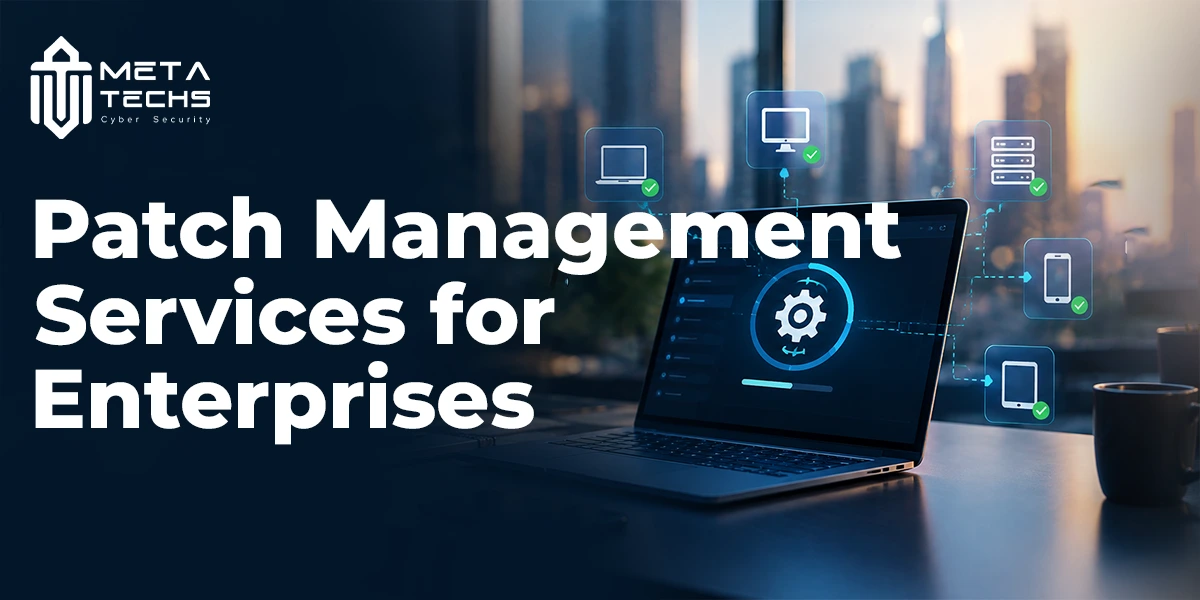
Patch management services for enterprises help organizations identify missing updates, assess their risk, prioritize remediation, deploy patches, and verify that systems were actually updated. NIST defines enterprise patch management as the process of identifying, prioritizing, acquiring, installing, and verifying patches, updates, and upgrades throughout an organization.
The important point is that enterprise patching is not simply about installing every available update as quickly as possible. It requires a structured approach that considers business criticality, vulnerability risk, testing, system availability, and what to do when a patch cannot be applied immediately.
Book a Free Patch Management Assessment
What Is Patch Management?
Patch management is the ongoing process of keeping operating systems, applications, firmware, and other software updated with relevant security and functionality fixes.
A mature patch management program starts with visibility. An organization needs to know which systems it owns, what software they are running, which patches are missing, and which vulnerabilities create the greatest risk.
From there, security and IT teams can prioritize vulnerability patching based on factors such as exploitability, asset importance, exposure, and potential business impact. Patches may then be tested, deployed through an appropriate maintenance process, and verified after installation.
This is why patch management is broader than downloading updates. It combines technology, policy, risk assessment, and operational processes. NIST recommends an enterprise-wide strategy to make patching easier to operationalize and to reduce security and operational risk.
Organizations looking at the relationship between vulnerability discovery and remediation can also review Meta Techs’ Vulnerability and Patch Management.
Why Unpatched Systems Are a Top Attack Vector
Attackers do not necessarily need to discover a completely new weakness to compromise an organization. A vulnerability that has already been disclosed and remains unpatched can provide an opportunity when the affected system is exposed and the vulnerability is exploitable.
This is why patching speed matters, but speed should be considered alongside risk.
CISA maintains its Known Exploited Vulnerabilities catalog to help organizations prioritize vulnerabilities that have been exploited in real-world attacks. Its guidance also recognizes that remediation may sometimes require compensating measures when a patch cannot be applied immediately.
For an enterprise, the practical question is therefore not simply, “How many patches are missing?”
It is more useful to ask which missing patches affect important assets, which vulnerabilities are actively being exploited, which systems are exposed to the internet, and where a delay creates meaningful business risk.
This approach prevents security teams from treating every update as equally urgent.
Manual vs Automated Patch Management
Manual patching can work in a small and relatively stable environment. As the number of devices and applications increases, however, manually tracking every update becomes difficult. Administrators may miss devices, apply patches inconsistently, or spend significant time checking whether remediation actually happened.
Patch management software can automate many repetitive activities, including asset discovery, patch assessment, deployment, scheduling, and reporting. Automation can make enterprise patching more consistent, but it does not remove the need for human oversight.
| Area | Manual patch management | Automated patch management |
| Deployment | Administrator-driven | Policy and workflow-driven |
| Scale | Becomes difficult as assets increase | Better suited to larger environments |
| Consistency | Depends on individual processes | More standardized |
| Reporting | Can be fragmented | Centralized reporting is possible |
| Testing | Often handled manually | Can be incorporated into workflows |
| Emergency remediation | May require significant coordination | Can accelerate approved deployments |
Automation also should not mean “patch everything immediately.” Critical applications may require testing before deployment, while production systems may need maintenance windows or rollback planning.
NIST’s enterprise patching guidance addresses both routine and emergency patching and the need to use existing tools and processes effectively.

Building a Patch Management Policy
Technology alone cannot create a reliable patching program. Enterprises also need a policy that defines how patching decisions are made.
A good policy should establish ownership, asset scope, risk priorities, testing requirements, deployment expectations, exception handling, verification, and reporting.
The policy should also account for systems that cannot be patched immediately. A business-critical application, for example, may require additional testing before an update can be introduced into production.
In such situations, the organization needs a documented decision rather than an indefinite exception. Access restrictions, isolation, configuration changes, increased monitoring, or other compensating controls may be appropriate depending on the system and vulnerability.
CISA guidance similarly recognizes that when a patch cannot be applied promptly, organizations may need other measures such as limiting access, isolating affected assets, changing configurations, or increasing monitoring until the patch can be safely deployed.
Patch management best practices therefore involve more than setting an automatic update schedule. They require a repeatable process for deciding what should happen when the normal patching path is not possible.
Patch Management for Endpoints, Servers & Cloud
Enterprise environments rarely have a single type of system to maintain.
Endpoints such as employee laptops and desktops can contain operating systems, browsers, productivity applications, security agents, and other third-party software. Endpoint patching needs accurate device visibility and a way to handle devices that are offline or outside the corporate network.
Servers require more careful planning because patching can affect business applications and services. Production systems may need testing, maintenance windows, dependency checks, and rollback procedures.
Cloud environments introduce another layer of responsibility. The organization still needs to understand which components it controls and which responsibilities belong to the cloud provider. Operating systems, applications, containers, virtual machines, and other workloads may have different patching requirements depending on the architecture and service model.
The goal is not to apply one identical process everywhere. It is to maintain visibility and consistent risk-based decision-making across the different environments.
This is particularly important as enterprises combine traditional infrastructure with cloud services and remote endpoints.
Application Control & Whitelisting as a Complementary Layer
Patching is not the only way to reduce software-related risk.
Application control can provide an additional layer by controlling which applications or software components are permitted to execute. Whitelisting, also commonly called application allowlisting, can help prevent unauthorized software from running even when an organization cannot immediately patch every affected system.
The distinction matters.
Patching addresses the underlying software weakness. Application control restricts what can execute.
Neither replaces the other.
Consider a critical application with a newly disclosed vulnerability. If the business cannot immediately apply the patch because of compatibility or operational concerns, application control and other compensating measures may help reduce exposure while remediation is being planned.
That does not make the vulnerable application safe indefinitely. The underlying patch still needs to be addressed.
A layered approach is therefore more practical for enterprise environments. Patch management reduces known software weaknesses, while application control can provide additional control over what is allowed to run.
Speak With a Patch Management Specialist
Meta Techs Managed Patch Management Services
Managing patches across a growing enterprise can become difficult when vulnerability discovery, prioritization, deployment, verification, and reporting are handled separately.
Meta Techs provides vulnerability and patch management services designed around identifying vulnerabilities, prioritizing remediation, deploying patches, supporting automation, and verifying remediation. Its existing service information also describes ongoing monitoring and reporting as part of the process.
The company positions patch management within its broader Endpoint & Server Security portfolio, alongside capabilities such as endpoint hardening, server hardening, EDR, XDR, device control, and application control.
For organizations that need to understand the operational process in more detail, Meta Techs’ Patch Management Process explains the stages involved in assessing assets, identifying missing patches, prioritizing risk, testing, deployment, verification, and monitoring.
The objective is not simply to increase the number of patches installed. A useful enterprise program should help security and IT teams understand which weaknesses require attention first, what has been remediated, and where risk remains.
Book a Vulnerability & Patch Management Consultation
FAQs
How often should patches be applied?
There is no single schedule that works for every organization. Critical vulnerabilities, especially those known to be actively exploited, may require much faster remediation than routine updates. Other patches may be handled through scheduled maintenance windows after appropriate testing.
The right frequency depends on the vulnerability, affected asset, business impact, exploit activity, and organization’s patch management policy.
What’s the difference between patch management and vulnerability management?
Vulnerability management is the broader process of discovering, assessing, prioritizing, and managing security weaknesses.
Patch management is one important remediation process used to address vulnerabilities by deploying available software updates. Not every vulnerability can be fixed through a patch, so vulnerability management may also involve configuration changes, compensating controls, mitigation, or other remediation methods.
Can patch management be fully automated?
Many parts of patch management can be automated, including discovery, assessment, deployment, scheduling, and reporting. However, enterprises still need human oversight for risk prioritization, testing, exceptions, maintenance windows, and systems where automated deployment could affect availability.
Automation can reduce repetitive work, but it does not eliminate the need for a patch management policy.
What is application control and how does it relate to patching?
Application control determines which applications or software components are allowed to execute on a system. It can provide an additional layer of protection when patching cannot happen immediately.
It does not replace patching. Application control helps restrict software execution, while patching addresses vulnerabilities within the software itself.
Final Takeaway
Enterprise patch management is not just an IT maintenance task. It is a structured security process that connects asset visibility, vulnerability patching, prioritization, testing, deployment, and verification.
The biggest challenge for large organizations is rarely knowing that patches exist. It is deciding which systems need attention first, how quickly they should be addressed, and what controls should be used when immediate patching is not practical.
That is where structured patch management services for enterprises can provide value. By combining vulnerability information with controlled deployment, verification, and ongoing monitoring, organizations can make patching a repeatable part of their cybersecurity program rather than a collection of manual fixes.