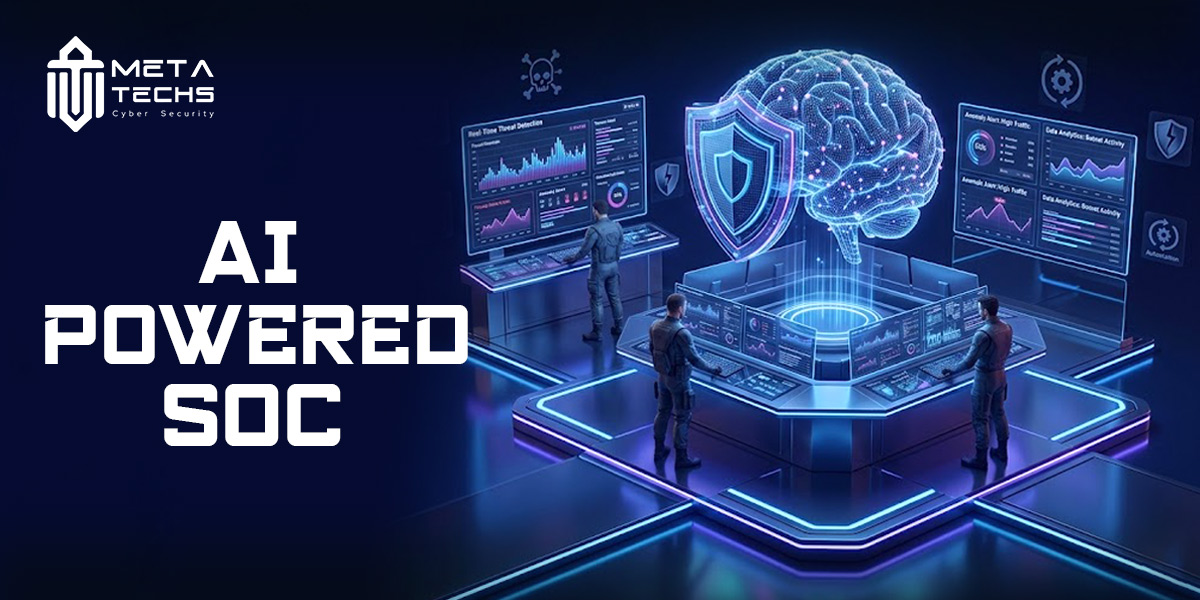
AI Powered SOC is the redefine of the traditional security system by using artificial intelligence as the smart brain which keeps you protected.
What Is an AI-Powered SOC?
In an environment full of data that needs to be controlled, it’s very hard to depend on human protection. This is where AI-powered SOC comes in. to be the new approach to cybersecurity. By using artificial intelligence to be responsible in detection, analyzation & responding to threats.
Simply, AI brings automation to the traditional security operations. Instead of just reacting to alerts, the system can analyze behavior, learn patterns, and act faster than humans.
Five Core Capabilities of a True AI SOC
Adding AI tool to any system gives it a smarter capabilities like:
1- Detecting the abnormal behaviour in seconds
By collecting data to monitor all events like logins and access AI powered SOC automatically helping to detect zero-day attacks and unknown threats
2- System and human behaviour analysis
How to know the abnormal actions without knowing the normal ones?
AI could build a model of a normal behaviour of system like process and applications and human behaviour like the location & time of login and the used devices
This model could find any suspicious actions like login from unknown locations or having access to sensitive data.
3- Reduce and prioritise the number of alerts
Imagine your team has thousands of alerts daily and they have to filter them to know the real threats. It’s just a waste of time.
AI could help your team to prioritise daily threat alerts and classifying them based on severity (Low / Medium / Critical) to know the context to each alert (who, where, how, why)
So now your team focuses on the most critical ones instead of thousands.
4- Automated threat response
Maybe the winning capability of AI powered SOC the actions they could take.
Without any human interactions AI could stop any suspicious accounts to block the unknown users or resetting credentials to stop any harmful activities and preventing communication with threat sources.
5- Find and eliminate threats before they cause damage.
AI-powered SOC goes beyond detection by enabling proactive threat hunting, actively searching for hidden or advanced threats that may bypass traditional security controls.
For example:
AI can detect slow, low-profile attacks that spread over time without triggering immediate alerts.
Challenges of Traditional SOCs
Traditional Security Operations Centers (SOCs) play a critical role in protecting organizations, but they often struggle to keep up with today’s fast-evolving threat landscape. As cyberattacks become more sophisticated and environments more complex, several key challenges limit their effectiveness:
1- The Massive Data and Alert Fatigue
Security tools generate thousands of alerts daily, many of which are false positives.
Analysts spend a lot of time reviewing priority alerts, which can lead them to miss the critical ones or respond to the real threats late.
2- Lack of Experts Who Can Do The Manual Processes
Traditional SOCs rely heavily on manual investigation and response. Which means that all the processes should be done by humans and there is a global shortage of experienced cybersecurity professionals.
without the existence of experts who can do it you will be facing slow detection and response times and inconsistent decision-making
3- Limited Visibility
With modern environments spanning on-premises, cloud, and hybrid systems, traditional SOCs often lack full visibility across all assets. Which blind spots in security monitoring and correlating events across systems difficulty
4- Difficulty in Facing the Premium Threats
Traditional security tools are mostly rule-based and rely on known threat signatures.
This makes it hard to detect the advanced threats like zero-day attacks
Key Aspects of an AI-Powered SOC
An AI-powered Security Operations Center (SOC) is built on several core components that work together to enhance detection, response, and overall security operations:
1- Data Integration & Visibility
An AI-powered SOC collects and centralizes data from multiple sources, including endpoints, networks, cloud platforms, and applications.
This unified visibility enables better analysis and faster identification of threats across the entire environment.
2- Machine Learning & Analytics
AI models analyze large volumes of data to identify patterns, anomalies, and potential threats.
Unlike traditional systems, these models continuously learn and improve detection accuracy over time.
3- Behavioral Analysis
The system establishes a baseline of normal user and system behavior, then detects deviations that may indicate malicious activity or insider threats.
4- Threat Intelligence Integration
AI-powered SOCs incorporate global threat intelligence feeds to stay updated on the latest attack techniques, indicators of compromise (IOCs), and emerging threats.
5- Automated Detection & Response (SOAR)
Automation enables immediate action when threats are detected, such as isolating devices, blocking access, or containing attacks without human delay.
6- Alert Correlation & Prioritization
AI correlates multiple alerts into a single incident and prioritizes them based on risk level, reducing noise and helping analysts focus on critical threats.
7- Continuous Monitoring (24/7)
AI systems operate continuously, providing real-time monitoring and rapid detection of suspicious activity at any time.
8- Scalability & Adaptability
AI-powered SOCs can scale easily, while adapting to new threats and evolving environments.
9- Collaboration Between AI & Human
AI enhances, not replaces, human analysts.
Security teams focus on investigation and strategy, while AI handles repetitive and data-heavy tasks.
Benefits of an AI-Powered SOC
An AI-powered Security Operations Center (SOC) delivers significant advantages over traditional security approaches by combining intelligence, automation, and scalability.
1- Fasting in detecting threats in real time to reduce and waste time of the organization in responding time.
2- Flirting and prioritizing high-risk alerts to help teams to focus on the most critical threats, improving efficiency and reducing overload.
3- AI enables proactive threat hunting and early detection of suspicious activities before they escalate into major incidents.
4- AI-powered SOCs can handle large volumes of data and growing infrastructure without requiring proportional increases in human resources.
5- By automating repetitive tasks and reducing the need for large security teams, organizations can lower operational costs while maintaining strong security.
Top Use Cases for AI SOCs
AI-powered SOCs are transforming cybersecurity operations by enabling a wide range of advanced use cases that improve both efficiency and security outcomes. One of the primary use cases is real-time threat detection, where AI continuously monitors networks, endpoints, and cloud environments to identify suspicious activity, including unknown and zero-day threats. It also plays a critical role in detecting insider threats by analyzing user behavior and flagging unusual actions such as abnormal access or data movement. In addition, AI enhances phishing and email security by identifying malicious content, spoofed domains, and suspicious communication patterns before they reach users.
Related posts:
 Security Operations Center (SOC) in UAE Explained
 What is SOC as a Service (SOCaaS)?
 5 Benefits of Security Information Event Management (SIEM)
 What Is a Threat Intelligence Platform (TIP)? How It Works, Key Features & Business Benefits
 The Key Benefits f AI In Cybersecurity
 Network Security Monitoring Solution: Types & Benefits