A company decides it needs 24/7 security monitoring. The first thought is often to buy a SIEM, connect a few security tools, and start watching alerts.
That sounds simple until the first serious alert arrives at 2:17 AM.
Who sees it? Who investigates it? Who decides whether it is a real attack? And if it is, who takes action?
That is the difference between buying security technology and building a Security Operations Center (SOC). A working SOC needs people, processes, technology, and a clear way to respond when something goes wrong. The real decision is not simply whether to build or outsource. It is deciding which security operations your organization can realistically own and operate.
What Does a SOC Actually Do?
Imagine an employee’s account suddenly logs in from an unusual location, followed by several failed authentication attempts and access to a sensitive application.
One security tool may generate an alert for each event. A SOC connects those events, investigates what happened, decides how serious the activity is, and determines what should happen next.
A SOC continuously monitors security data, investigates suspicious activity, identifies potential threats, and coordinates the response to confirmed incidents. Its work can include network and endpoint monitoring, alert triage, threat detection, incident investigation, escalation, and reporting. This connects directly with a documented incident response plan that defines what happens after detection.
The response process matters just as much as detection. NIST’s current incident response guidance treats preparation, detection, response, and recovery as connected parts of cybersecurity risk management rather than isolated activities.
Buying security tools is not the same as building a SOC
You can have a SIEM collecting thousands of logs and still miss something important if nobody has the time or expertise to investigate them. You can have endpoint protection on every laptop and still struggle to understand what happened during an account compromise.
The tools create visibility. People and processes turn that visibility into action.
That distinction should shape the entire SOC plan.
Related reading
-> Security Operations Center (SOC) Services
-> SIEM in Dubai: How It Works
What Does It Take to Build an In-House SOC?
Building an in-house SOC means taking responsibility for the people, technology, processes, and day-to-day security operations yourself.
There is no single technology stack that works for every organization. MITRE’s guidance on building effective cybersecurity operations centers emphasizes choosing the right structure and functions for the organization’s mission, staffing the team, collecting useful data, using threat intelligence, and measuring SOC performance.
People
Start with the team, not the software.
An in-house SOC may include Tier 1 analysts who monitor and triage alerts, Tier 2 analysts who investigate incidents, and more experienced Tier 3 analysts who handle threat hunting, detection engineering, and complex investigations. A SOC manager is responsible for coordinating operations, team development, and major security incidents. The top IT security companies in Dubai typically structure their SOC teams this way.
The exact structure depends on the organization’s environment and workload. What matters is having enough capability to move an alert from “something looks unusual” to “we understand what happened and know what to do next.”
Technology
The technology layer usually brings together several security capabilities.
A SIEM can collect and correlate security events. EDR or XDR can provide visibility into endpoint activity. SOAR can automate repetitive response tasks. Threat intelligence can add context about suspicious indicators and known attack activity. Log management and network monitoring may also be required depending on the environment.
But buying all of these tools at once is not necessarily a good starting point. The better question is: What do we need to detect? If the organization cannot explain which threats its SOC is expected to identify, adding more tools may simply create more alerts.
Processes
Someone needs to decide what happens after an alert appears. A mature SOC should have documented procedures for triage, investigation, escalation, containment, communication, and reporting. These processes should connect with the organization’s wider incident response plan.
NIST recommends integrating incident response into broader cybersecurity risk management so organizations can improve the effectiveness of detection, response, and recovery. That means the SOC should not operate as an isolated technical team. It needs a clear relationship with IT, management, compliance, legal, and other teams that may become involved during a serious incident.
Coverage
Finally, decide when the SOC needs to be watching.
Business-hours monitoring is very different from genuine 24/7 security operations. If critical systems are exposed around the clock, an organization needs a sustainable way to investigate high-priority events outside normal working hours. SANS’ 2024 SOC survey found that only 20% of surveyed SOCs did not operate 24/7, while nearly half of the 24/7 organizations used a follow-the-sun model.
That is why coverage should be decided before staffing and technology budgets are finalized.
A SOC is an operating model, not a collection of software.
Unsure whether to build in-house or outsource your security operations? Talk to our security operations experts
What Does a 24/7 SOC Team Actually Look Like?
The phrase “24/7 monitoring” sounds straightforward. The staffing behind it is not.
A common SOC structure divides analyst responsibilities into tiers.
Tier 1 analysts handle the first review of security alerts. They determine whether an event looks suspicious and escalate cases that need deeper investigation.
Tier 2 analysts investigate those escalated events in more detail. They may examine logs, endpoint activity, authentication records, and other evidence to understand the scope of an incident.
Tier 3 analysts generally handle more advanced work such as threat hunting, detection engineering, and complex investigations. This is also where operational threat intelligence becomes particularly valuable.
A SOC manager coordinates the operation and connects technical work with business priorities.
But these roles do not automatically mean an organization needs exactly three separate teams. Smaller SOCs may combine responsibilities, while larger organizations may have additional specialists.
The real question is simpler: Who responds when the alert arrives outside office hours? If the answer is “someone from IT will check it when they can,” the organization may have monitoring, but it does not have the same operational capability as a properly staffed 24/7 SOC.
That staffing requirement is one reason building an in-house SOC can become expensive. For many organizations, SOC as a Service provides a more practical path to 24/7 coverage.
How Much Does It Cost to Build an In-House SOC?
There is no useful universal price for building an in-house SOC.
The cost depends on the number of assets being monitored, security tools, log volume, staffing model, required coverage, infrastructure, and the level of expertise the organization needs.
The main cost areas usually include:
- SOC analysts and security engineers
- SIEM licensing and infrastructure
- EDR or XDR
- Log storage and data processing
- Threat intelligence
- Security automation
- Training and certifications
- 24/7 staffing
- Maintenance and ongoing tool management
The software bill is only one part of SOC cost.
SANS’ 2024 SOC survey found that 38% of respondents said their organization’s SOC budget was “unknown,” highlighting how difficult it can be to connect security operations with actual business budgeting. The same survey identified staffing requirements and skilled staff shortages among the major challenges facing SOC teams.
So when calculating the SOC setup cost, do not ask only, “How much will the SIEM cost?” Ask: How much will it cost us to operate this capability every day, including nights, weekends, people, training, maintenance, and incident response? That number gives you a much more realistic basis for comparing an in-house SOC with an outsourced model.
Is an In-House SOC Worth It for Every Business?
Not necessarily.
Company size can influence the decision, but it should not make the decision by itself. A company with an experienced security team, complex infrastructure, strict internal-control requirements, and enough resources to maintain continuous operations may have a strong case for building an in-house SOC. Another organization may have equally serious security requirements but lack the people or resources to run one effectively.
That is where outsourcing becomes worth considering. Before deciding, look at five things: internal security expertise, required monitoring coverage, environment complexity, total operating budget, and required level of internal control. The goal is not to build the biggest SOC. It is to build a security operation that can actually detect, investigate, and respond when something happens.
In-House vs Outsourced SOC: Which Model Makes Sense?
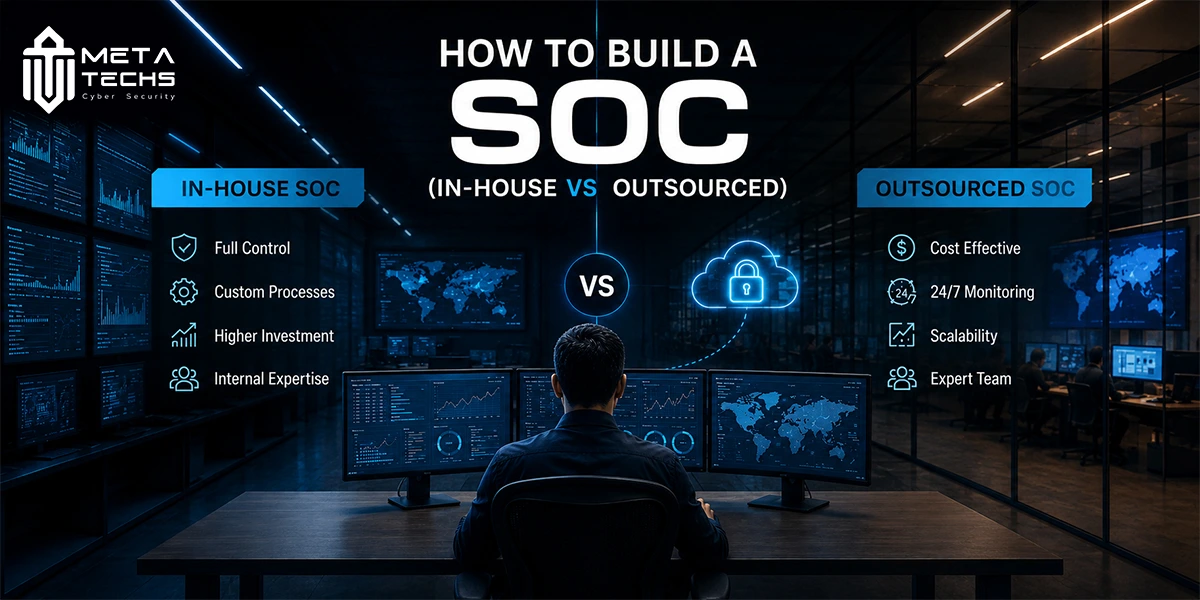
Building a SOC internally gives you control. Outsourcing gives you access to people and capabilities you may not have in-house. Neither option is automatically better. The more useful question is what your organization needs to own, what it can realistically operate, and where an external team can fill the gaps.
What Are the Pros and Cons of an In-House SOC?
An in-house SOC makes sense when security operations are closely tied to the organization’s systems, people, and risk decisions. Your own team knows the environment, understands why certain systems matter, and can work directly with IT when something goes wrong.
That level of control is valuable. You can build detection rules around your own environment, decide how incidents are escalated, and keep security operations closely connected to internal teams.
There is a cost, though. You have to recruit and retain security analysts, manage the technology stack, maintain detection rules, train the team, and provide the coverage you promised. If the SOC is expected to operate 24/7, staffing becomes an even bigger consideration.
SANS’ SOC research shows that staffing remains a recurring challenge, while its 2026 survey identified lack of enterprise-wide visibility as the leading barrier to SOC effectiveness among surveyed cyber leaders.
So the trade-off is fairly simple: An in-house SOC gives you more control, but control comes with responsibility. You do not just own the alerts. You own the people, processes, technology, and outcomes behind them.
When Does an Outsourced SOC Make More Sense?
Imagine a company with a capable IT team but no dedicated security analysts. The team can manage infrastructure during working hours. What happens when a high-priority security alert appears at midnight? Hiring an entire security operations team may not be practical. An outsourced SOC or SOC as a Service can fill that gap by providing security monitoring and specialist capabilities without requiring the company to build every part of the operation internally.
Depending on the provider and service scope, an outsourced SOC or SOC as a Service may include:
- 24/7 security monitoring
- Alert triage
- SIEM management
- Threat detection
- Incident investigation
- Threat intelligence
- Security reporting
- Incident escalation
The exact scope matters. “Managed SOC” can mean different things between providers, so buyers should understand what the service actually includes.
NIST’s guidance recognizes outsourcing as one way organizations can obtain incident-response capabilities, including using an external provider for SOC functions. Its small-business guidance also notes that outsourcing cybersecurity expertise can make strategic sense when an organization does not have the expertise, resources, or budget to build the capability internally.
The important distinction is that outsourcing does not remove responsibility for security. It changes who performs parts of the work. Your organization still needs to know who makes business decisions, who approves containment actions, and who owns the incident when something serious happens.
Related reading
-> Operational Threat Intelligence
-> Best EDR Software for Businesses
In-House vs Outsourced SOC: What Should You Actually Choose?
Start with your current capabilities, not your company size.
Decision guide:
Already has experienced security analysts -> In-house SOC
Needs complete operational control -> In-house SOC
Needs 24/7 monitoring but lacks enough staff -> Outsourced SOC
Has an overloaded IT team -> Outsourced SOC
Needs specialist expertise quickly -> Outsourced SOC
Wants internal ownership with external monitoring -> Hybrid SOC model
Has complex security operations but limited staffing -> Hybrid SOC model
A large company can still choose an outsourced SOC. A smaller company can build part of its security operations internally. There is not a rule that says one model belongs to one company size.
Look at the actual gap. If your internal team can investigate incidents, maintain detections, manage security tooling, and provide sustainable coverage, an in-house model may be reasonable. If the biggest problem is a lack of people or round-the-clock expertise, SOC as a Service may solve a more immediate problem.
And if you want internal control but do not want your own team watching alerts overnight, a hybrid model may be the better fit. In-house is not automatically better. Outsourcing is not automatically cheaper. The right model is the one that closes the security gap without creating an operating burden your organization cannot sustain.
Want to evaluate which SOC model fits your organization? Explore our managed SOC services
Can You Combine an In-House and Outsourced SOC?
Yes.
A hybrid SOC keeps some security responsibilities inside the organization while using an external provider for specific capabilities.
For example, the internal team might own: security strategy, incident decisions, business context, governance, and communication with leadership.
The external provider might handle: 24/7 monitoring, initial alert triage, SIEM operations, threat intelligence, and specialist investigation.
This arrangement can be useful when the organization wants to keep control over important security decisions but does not have enough people to provide continuous monitoring.
There is one issue that needs to be settled before the contract is signed: Who owns the incident after the provider detects it? Suppose the external SOC identifies a compromised administrator account. Does it isolate the account? Does it contact the internal IT team first? Who decides whether other systems should be taken offline?
If those responsibilities are not clear, the handoff can become the weakest part of the security operation. NIST’s incident-response guidance emphasizes clearly defined roles and responsibilities, including leadership decision-making and incident handlers responsible for analyzing and responding to incidents. See our incident response services for how this process is structured in practice.
A hybrid SOC works best when the division of responsibility is designed before the first incident, not during it.
What Should You Look for in a Managed SOC Provider?
Do not choose a managed SOC because the provider says “24/7 monitoring” on its website. Ask what actually happens after an alert is generated.
Before signing a contract, ask:
- Is monitoring genuinely available 24/7?
- What systems and data sources can the provider monitor?
- Who performs initial alert triage?
- What happens when a critical incident is confirmed?
- Who investigates the incident?
- How are false positives handled?
- What are the escalation procedures?
- What reports will the internal team receive?
- Where is security data stored?
- What response times are included in the SLA?
- Which actions can the provider take without approval?
- How does the service fit into your existing incident response process?
The last few questions are particularly important. A provider can detect an attack quickly and still create problems if your team does not know what happens next.
SANS has also highlighted the challenge of maintaining effective technical and human coordination between an organization and an external MDR provider in a 24/7 operating environment. So evaluate the working relationship, not just the technology.
How Meta Techs Managed SOC Services Work
Meta Techs is recognized among the top IT security companies in Dubai and positions its SOC services around monitoring, detection, response, and operational visibility. Its current SOC service portfolio includes 24/7 SOC monitoring, SIEM deployment and management, log management, threat hunting, incident detection, security alert monitoring, use-case development, SOC maturity assessment, managed SOC services, and MDR.
That range matters because not every organization needs the same level of external support. One company may need help managing its SIEM and monitoring alerts. Another may need broader 24/7 SOC coverage. A mature security team may only need specialist capabilities alongside its existing operation. Explore our SOC as a Service and cybersecurity solutions to understand the full range.
Meta Techs also positions itself as a UAE-focused cybersecurity provider with its base in Dubai. Its wider security portfolio connects SOC capabilities with threat intelligence, incident response, cloud security, compliance, and other security services.
For a UAE organization evaluating a managed SOC, the useful question is not simply whether a provider offers monitoring. It is whether the service fits the organization’s existing security team, infrastructure, response process, and regulatory requirements such as NESA or the UAE Personal Data Protection Law.
FAQs
How much does it cost to build an in-house SOC?
There is no fixed SOC cost. Staffing, security tools, infrastructure, log volume, training, and 24/7 coverage all affect the total operating cost. SOC as a Service can offer a more predictable cost model for organizations comparing options.
Is outsourcing a SOC less expensive?
It can be, particularly when the alternative is hiring and maintaining a complete security team. Compare the total cost and service scope of managed SOC services rather than the monthly provider fee alone.
Can you combine an in-house and outsourced SOC?
Yes. A hybrid SOC can keep security ownership and major decisions inside the organization while an external provider handles monitoring or specialist functions such as threat hunting and SIEM management.
How many people are needed for a 24/7 SOC?
There is no universal number. Staffing depends on alert volume, automation, shift structure, responsibilities, and the capabilities being handled internally or externally. SANS’ 2024 survey found that the most common SOC size was 2 to 10 people, while 24/7 operations were common among surveyed organizations. SOC as a Service removes the staffing burden entirely for organizations that need round-the-clock coverage.
Is SOC as a Service suitable for small businesses?
It can be. NIST notes that outsourcing cybersecurity expertise can be particularly practical for smaller businesses that lack the budget, resources, or expertise to build dedicated internal capabilities. See our guide on cybersecurity solutions for small business in Dubai for more context.
The better question is not whether you can afford a SOC. It is whether you can afford to have security alerts arrive when nobody is prepared to handle them.
Build or Outsource Your SOC with Confidence
Whether you are evaluating an in-house build, a fully managed service, or a hybrid model, Meta Techs can help you design a security operations approach that matches your environment, budget, and risk profile. Our SOC as a Service provides 24/7 monitoring, threat detection, and incident response without the overhead of building and staffing an entire team internally.
Contact our security operations team today to discuss your SOC requirements and find the right model for your organization.