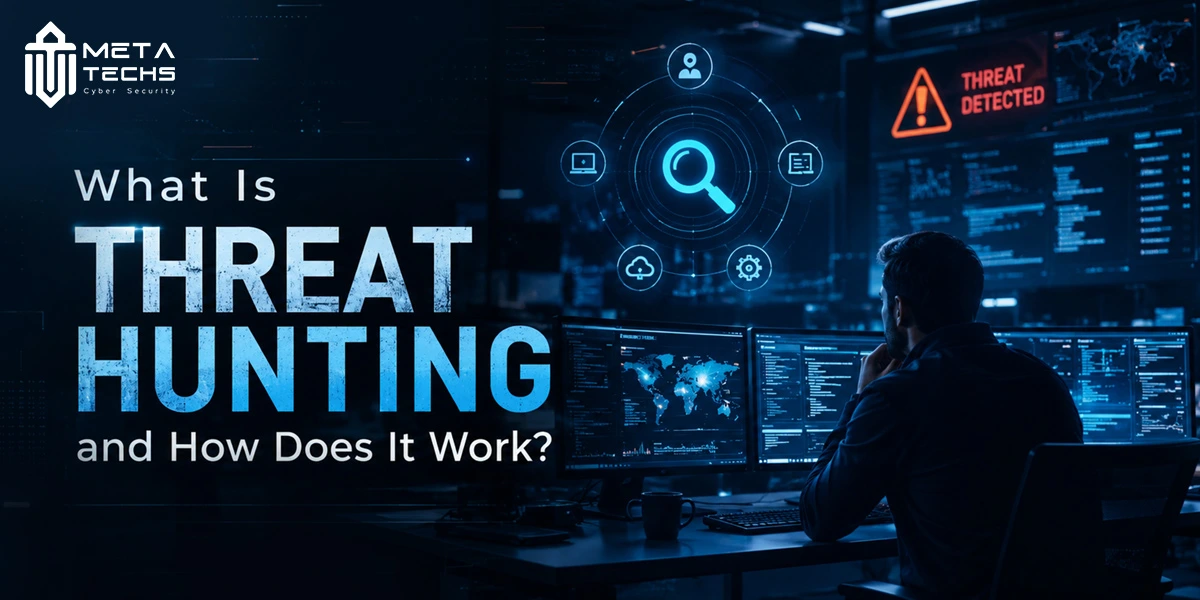
Your security tools may be watching your network every second, but that does not mean every threat will trigger an alert. An attacker using stolen credentials, a legitimate application, or small changes in normal system activity can sometimes stay below the radar.
That is where threat hunting comes in. Instead of waiting for a security alert, threat hunters actively look for signs of suspicious activity that existing controls may have missed. They form a hypothesis, investigate security data, follow unusual patterns, and validate what they find. The goal is not to replace automated detection. It is to find the gaps in it, then use those findings to make future detection stronger. This is one of the most effective ways to stay ahead of the top cybersecurity threats facing organizations today.
What Is Threat Hunting?
Your security tools can watch thousands of events at once. But an alert only helps when something triggers it.
Threat hunting takes a different approach. Instead of waiting for a warning, security teams actively look for signs that an attacker may already be inside the environment or that suspicious activity has gone unnoticed. Imagine an employee account suddenly accessing systems it normally never touches. Nothing may immediately classify that activity as malicious. A threat hunter can investigate the account’s login history, endpoint activity, network connections, and other related signals to see whether those events form a pattern. This is closely connected to how a Security Operations Center operates — both rely on the same security data, but threat hunting goes a step further by searching for what monitoring may have missed.
That is the real value of proactive threat detection. The goal is not to replace your existing security controls. It is to look for the gaps between what those controls can detect and what an attacker might actually be doing.
Threat Hunting vs Threat Detection
The easiest way to understand the difference is to look at what starts the investigation.
Threat detection usually starts with a signal. Threat hunting can start with a question.
A detection system might flag a known malicious file, unusual login, or suspicious command. A security analyst then investigates the alert. During a hunt, the analyst might instead ask, “Could someone be using stolen credentials in our environment without triggering an alert?” From there, the hunter searches for evidence across available security data and connects activity that may look harmless when viewed separately. Tools like SIEM are essential for this kind of cross-system investigation.
So the two are not competitors. Detection watches for known or suspicious signals. Hunting actively looks for what might have been missed. Together they form the foundation of a strong SOC operation.
Related reading
-> Security Operations Center (SOC) Services
-> Operational Threat Intelligence
-> Recent Threats in Cyber Security
The Threat Hunting Process, Step by Step
A hunt usually begins with a hypothesis, not a random search through millions of logs.
- Create a hypothesis: The hunter starts with a specific question based on threat intelligence, a recent incident, suspicious behavior, or a known attacker technique.
- Search security data: The hypothesis is tested against available telemetry, such as endpoint, identity, network, cloud, and log data. The hunter looks for traces that support or disprove the idea.
- Investigate suspicious behavior: One unusual event rarely tells the whole story. The hunter follows related activity across users, devices, applications, and systems to understand what actually happened.
- Validate the finding: The team checks whether the pattern is genuinely malicious, expected business activity, or simply noise. This step matters because a hunt that produces hundreds of false positives is not particularly useful.
- Improve detection and respond: If the investigation uncovers a repeatable malicious pattern, the finding can be turned into a new detection, threat intelligence, or incident response
MITRE ATT&CK can help structure this investigation. Its knowledge base organizes real-world adversary behavior into tactics and techniques, giving defenders a common way to describe what an attacker is trying to achieve and how they may do it. For example, instead of simply searching for “suspicious activity,” a hunter could investigate whether an attacker is using Valid Accounts for access, followed by Discovery or Lateral Movement behaviors. This framework also connects to penetration testing exercises, which simulate these same attacker techniques to validate defenses.
The important part is what happens after the hunt. You are not just looking for one hidden threat. You are learning what your existing detection missed and using that knowledge to make the next hunt easier.
Want to find out what your current security controls might be missing? Explore our SOC and threat hunting services ->
What Tools and Techniques Do Threat Hunters Use?
A threat hunter does not rely on one security product. The investigation usually brings together several sources of evidence, because an attack rarely leaves its entire story in one place.
Core tools and their role in a hunt:
SIEM — correlate and search security events across systems
EDR/XDR — investigate endpoint and cross-environment activity
Threat intelligence — identify relevant threats, indicators, and attacker behavior
Telemetry analysis — find patterns across logs, identities, networks, and cloud systems
MITRE ATT&CK — map suspicious behavior to known adversary techniques
AI-assisted analysis — process large volumes of data and speed up investigation
A SIEM helps analysts search and correlate security events from different systems. Instead of looking at individual logs, a hunter can connect events across users, endpoints, applications, and network activity to find a pattern.
EDR and XDR provide another layer of visibility. They can show what happened on an endpoint, which processes ran, how a device communicated with other systems, or whether the same suspicious behavior appeared elsewhere.
Then there is threat intelligence. Information about known attackers, malware, infrastructure, or techniques can give a hunter a reason to investigate a particular behavior rather than searching blindly. Our guide on operational threat intelligence covers how this data is collected and used in practice.
The investigation itself depends heavily on log and telemetry analysis. A single unusual login may mean nothing. That same login followed by privilege changes, unusual process activity, and access to unfamiliar systems tells a very different story.
MITRE ATT&CK helps organize this thinking. Its knowledge base maps adversary tactics and techniques based on real-world observations, giving security teams a common way to describe and investigate attacker behavior. AI-powered cyber threats are also changing this landscape, with attackers now using automation to move faster and leave fewer obvious traces.
AI can also speed up parts of the investigation. It can help analysts sort large amounts of data, identify relationships, or research unfamiliar activity. But that does not make the human investigator unnecessary. Someone still has to decide whether a pattern makes sense in the context of that particular environment.
The tools provide the evidence. The hunter decides what the evidence means.
Related reading
-> SIEM in Dubai: How It Works
-> Best EDR Software for Businesses
-> Operational Threat Intelligence
Why Does Proactive Threat Hunting Matter?
Having security tools in place does not mean every threat will immediately become an alert. An attacker might use legitimate credentials, abuse a trusted application, or make small changes that do not look suspicious on their own. Hunting gives security teams a way to actively investigate these gaps instead of assuming that everything outside the alert queue is safe. This is one of the reasons why the recent threats in cyber security landscape has pushed more organizations toward proactive detection models.
There is another benefit that is easy to overlook. A successful hunt can improve the security system itself. Once analysts understand how a particular attack behaves, that knowledge can be used to create or improve detections. The next time similar activity appears, the organization has a better chance of identifying it automatically. This is the same principle behind vulnerability scanning — find the gap, close it, then verify it is closed.
That creates a useful cycle: Hunt -> investigate -> learn -> improve detection -> hunt again.
For businesses in the UAE, this can be particularly useful where security teams need visibility across cloud environments, endpoints, identities, networks, and other business-critical systems. Threat hunting can complement monitoring and incident response by helping teams investigate activity that existing controls may not have surfaced clearly.
The point is not to add another security product just because it sounds advanced. The value comes from finding the gaps in your existing visibility and doing something useful with what you discover. For organizations looking for threat hunting services in the UAE or Dubai, the right approach should fit into the wider security operation rather than operate as an isolated exercise. Cybersecurity consulting can help define where threat hunting adds the most value in your specific environment.
Meta Techs Threat Hunting Services
Meta Techs is recognized among the top IT security companies in Dubai and includes Threat Hunting within its Security Operations Center (SOC) services, alongside 24/7 monitoring, SIEM management, log management, incident detection, use-case development, and managed SOC services. Its broader security portfolio also includes threat intelligence, EDR/XDR, incident response, and managed security services.
That combination matters because hunting works best when investigators have access to the security data and context they need. For a business in Dubai or elsewhere in the UAE, the practical goal is not simply to search for hidden threats. It is to connect monitoring, investigation, intelligence, and response so that findings can lead to action. Explore our full range of cybersecurity solutions to understand how threat hunting fits into a broader security strategy.
FAQs
Is Threat Hunting the Same as SOC Monitoring?
No. SOC monitoring continuously watches security events and alerts for suspicious activity, while threat hunting actively searches for threats that may not have triggered an alert. The two work together, with hunting helping identify gaps that monitoring may not catch.
How Often Should Threat Hunting Be Performed?
There is not one schedule that works for every organization. The frequency depends on factors such as the organization’s risk level, industry, available telemetry, recent incidents, and security maturity. Higher-risk environments may need more frequent or continuous hunting, while others may conduct targeted hunts around specific threats or threat intelligence findings.
What Skills Does a Threat Hunter Need?
A threat hunter needs more than knowledge of security tools. They need to understand attacker behavior, analyze logs and telemetry, investigate unusual patterns, work with threat intelligence, and form useful hypotheses. Familiarity with frameworks such as MITRE ATT&CK can also help them connect observed activity with known adversary techniques.
Can Automated Tools Replace Human Threat Hunters?
Not completely. Automation can process huge amounts of security data and identify patterns much faster than a person can. AI-powered tools are increasingly used to speed up this process. But human hunters provide context, create hypotheses, investigate unusual behavior, and decide whether an apparent pattern actually represents a threat. The strongest approach combines automation with human investigation.
Find the Threats Your Security Tools Are Missing
Automated detection catches known threats. Threat hunting finds what falls through the gaps. Meta Techs provides threat hunting as part of its SOC services, combining human investigation with threat intelligence and SIEM-powered telemetry to uncover hidden activity before it becomes a serious incident.
Contact our security operations team today to discuss how threat hunting can strengthen your existing security defenses.
Related posts:
 What Is a Threat Intelligence Platform (TIP)? How It Works, Key Features & Business Benefits
 New Era of Operational Threat Intelligence
 What is AI Powered SOC? Capabilities & Benefits
 HookChain: A New Threat to Bypass EDR
 Managed Detection and Response (MDR) Services: The Complete Guide
 What Is VMware Carbon Black?