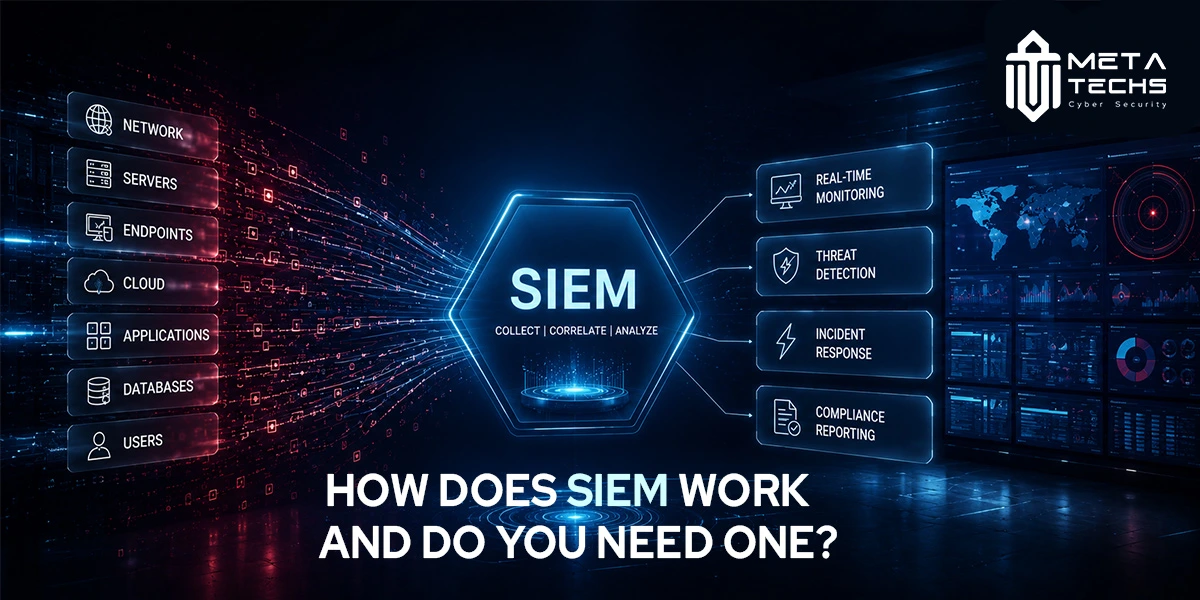
A firewall can tell you that a connection was blocked. Your identity system can show a suspicious login. An endpoint tool might flag unusual activity on a device. The problem starts when those events happen across different systems and nobody has the full picture.
That is the gap a Security Information and Event Management (SIEM) solution is designed to address. It brings security logs and events from different parts of your environment into one place, where they can be searched, analyzed, and correlated. That gives security teams a broader view of what is happening instead of making them investigate each system separately. For a deeper look at how SIEM fits into a full security operation, see our guide on how to build a SOC.
But buying SIEM software does not automatically mean your security team will spot every attack. The platform still needs the right data, detection rules, people, and response processes behind it.
What Is SIEM?
Think about how many systems can generate security information in a normal business environment. There may be firewalls handling network traffic, endpoints recording device activity, cloud applications tracking user actions, and identity systems logging authentication attempts.
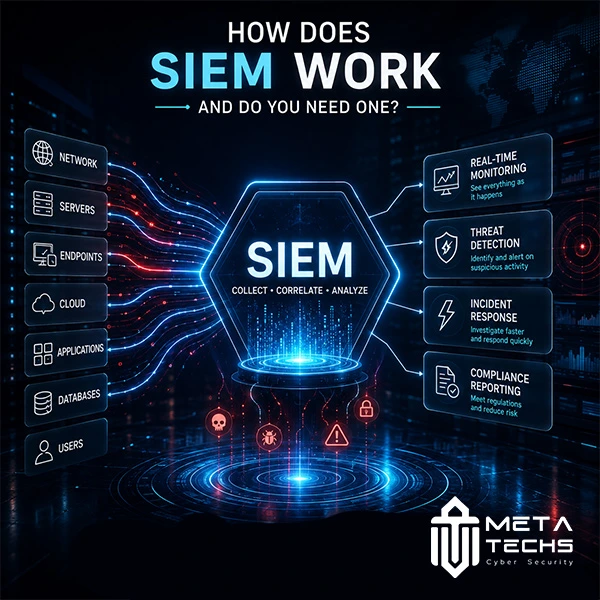
A SIEM solution brings those records together so they can be examined as part of the same security picture. It collects, organizes, and analyzes security logs and events, helping teams look for activity that may point to a threat. Centralized visibility is one of the main reasons organizations use SIEM for security monitoring, incident investigation, and compliance-related needs.
There is an important difference between collecting logs and making sense of them, though.
A business could store months of firewall, endpoint, and application logs and still struggle to understand what happened during an incident. SIEM adds analysis and event correlation, allowing related activity from different systems to be examined together. That becomes especially useful when an attack does not look suspicious from a single log entry.
How SIEM Collects and Correlates Data
The process starts with data collection. Depending on the environment, a SIEM may receive information from firewalls, servers, endpoints, cloud services, applications, identity systems, network devices, and other security tools.
The data will not necessarily arrive in a consistent format. One system might record a user’s activity differently from another, making direct comparison difficult. SIEM platforms normalize the incoming information so events from different sources can be analyzed together.
The interesting part is what happens after the data has been brought together.
Suppose an employee’s account records several failed login attempts. That is not necessarily a security incident. People forget passwords. Systems reject logins. It happens. Now add a successful login from an unusual location, followed by access to a sensitive application and an attempt to create a privileged account. The individual events tell you very little. The sequence tells you much more. This type of behavior pattern is exactly what threat hunters are trained to investigate.
This is where event correlation becomes useful. A SIEM can connect related events and apply detection rules or analytics to identify patterns that deserve investigation. Modern platforms may also use behavioral analytics and machine learning to identify unusual activity alongside traditional detection methods.
That does not mean a business should simply connect every possible log source and let the platform run. More data can create more noise. Teams need to decide which sources are relevant, define security use cases, configure detection rules, and adjust them as the environment changes. For a SIEM implementation to be useful, the question is not just how much data it can collect. It is whether the data helps the security team recognize something they would otherwise miss.
Want to know which data sources your SIEM should be monitoring? Talk to our security operations team ->
Related reading
-> SIEM in Dubai: How It Works
-> 5 Benefits of SIEM for Security Teams
-> SIEM Solutions Gartner Overview
What Happens After a SIEM Detects a Threat?
Once the system identifies a suspicious pattern, it can generate an alert for investigation. The security analyst then needs to examine the surrounding events, determine whether the activity is malicious, and decide what action should follow.
That distinction is easy to overlook.
A SIEM provides visibility and detection capabilities. It does not automatically mean that someone is watching every alert or responding to every incident. Some platforms can trigger automated actions or integrate with security orchestration and response tools, but organizations still need defined investigation and response workflows.
So SIEM deployment is only one part of the process. The real value comes when the collected data, detection logic, monitoring, and response process work together. A dedicated Security Operations Center is how most organizations ensure those elements are connected.
SIEM vs Log Management
The two terms often appear together, and for good reason. Log management is part of what many SIEM platforms do, but the two are not interchangeable.
A log management system is mainly concerned with collecting, storing, indexing, and searching records from your IT environment. That can be useful when you need to troubleshoot an application, investigate a past event, or meet a log-retention requirement.
SIEM takes that collected information a step further. It can analyze events from different sources, correlate them, apply detection rules, and surface activity that may need investigation. See our overview of the 5 benefits of SIEM for a more detailed breakdown of what this adds beyond basic log storage.
Key differences:
Log management: collects and stores logs, helps search historical records, primarily answers “What happened?”
SIEM: collects and analyzes security data, correlates events across systems, helps answer “What happened, and could these events be related?”
The distinction becomes important when an organization has more security data than its team can reasonably examine manually. At that point, simply keeping the logs is not enough. The business needs a practical way to turn those records into useful security signals.
Signs Your Business Needs a SIEM
Company size alone is not a good reason to buy or reject a SIEM. A smaller business with a complicated cloud environment may have more monitoring needs than a larger company with a relatively simple setup.
Look at what is happening inside your environment instead.
You have multiple security data sources
Your firewall sees network traffic. EDR records endpoint behavior. An identity provider records authentication events, while cloud applications and servers generate their own logs. When these systems operate separately, connecting events during an investigation can take time. A SIEM platform can bring those sources together for centralized analysis.
Manual monitoring is becoming difficult
Consider an organization with several offices, remote employees, cloud services, SaaS applications, VPN infrastructure, and on-premises systems. Checking each console separately may work when the environment is small. It becomes much harder when the number of systems and events keeps growing. SIEM software can give security teams one place to search and investigate activity across those sources.
Need broader security visibility
A security incident rarely stays inside one tool. An attacker might compromise an account, move to another system, access an application, and then attempt to transfer data. Seeing those steps together can provide more context than looking at each alert independently. That is one of the practical SIEM use cases: connecting activity across different parts of the environment so analysts can investigate a wider picture. Threat hunting builds on this visibility by actively searching for patterns that alerts may not surface.
Have compliance or log-retention requirements
Some organizations need to retain and produce security records for regulatory or industry requirements, including the UAE Personal Data Protection Law and NESA. A SIEM can centralize those logs and make them easier to search, investigate, and use for reporting. The exact requirements depend on the industry, location, and applicable framework, so SIEM should not be treated as a universal compliance shortcut.
Someone can operate it
This is easy to overlook. A SIEM can generate alerts, but someone still needs to investigate them, tune detection rules, review false positives, and maintain the system. If nobody has responsibility for those tasks, adding another security platform may simply create another dashboard. This is why many organizations pair SIEM with a managed SOC service.
Need more advanced threat detection
When an attack involves several systems, individual security tools may only show fragments of what is happening. SIEM can correlate those fragments and help identify patterns that deserve investigation. This is particularly relevant when dealing with ransomware that moves laterally across systems before deploying.
Not sure if your environment is complex enough to justify a SIEM? Request a security assessment ->
Challenges of Running SIEM In-House
Getting SIEM software installed is only the beginning.
Someone has to connect the right data sources, configure detection rules, manage data volume, investigate alerts, and keep adjusting the system as the environment changes. Poorly tuned rules can also produce large numbers of false positives, making it harder for analysts to distinguish genuine threats from routine activity. This is why many organizations use SOC as a Service to manage the operational layer of their SIEM deployment.
That operational workload is one reason SIEM deployment requires planning rather than a simple software installation. Defining objectives, prioritizing data sources, establishing response workflows, training staff, and regularly reviewing rules and alerts are all ongoing responsibilities.
Common challenges:
- Data integration: Connecting and maintaining the right log sources
- Alert fatigue: Reducing unnecessary alerts and false positives
- Rule tuning: Adjusting detections to match the environment
- Skilled staff: Having people who can investigate and respond
- Ongoing maintenance: Keeping integrations, rules, and monitoring processes current
- Cost: Accounting for software, data volume, infrastructure, and people
A SIEM can provide excellent visibility. The harder question is whether your business has the people and processes to turn that visibility into action. For organizations that need the capability without building the full team internally, managed SOC services offer a practical alternative.
Meta Techs SIEM Deployment & Management Services
Deploying SIEM is not just about installing software and connecting a few logs. The useful work starts with understanding the environment, deciding which data sources matter, and building detection use cases around the threats the organization actually faces.
That can include integrating logs from endpoints, firewalls, servers, cloud services, and identity systems, followed by configuring alerts and tuning detection rules. Ongoing management may also involve security alert monitoring, threat hunting, incident detection, and reviewing the system as the environment changes.
Meta Techs is recognized among the top IT security companies in Dubai and provides SIEM deployment and management as part of its security operations services, alongside log management, threat hunting, incident detection, security alert monitoring, use case development, and 24/7 SOC monitoring. These services can help organizations that need centralized security visibility but do not want to build every part of the monitoring function internally.
The important part is the approach. A SIEM should be configured around the organization’s environment and security requirements rather than treated as a standalone dashboard. Explore our full range of cybersecurity solutions to see how SIEM fits into a broader security strategy.
FAQs
What’s the difference between SIEM and SOC?
SIEM is a security technology platform that collects, analyzes, and correlates security data. A SOC (Security Operations Center) is the team or function responsible for monitoring that data, investigating suspicious activity, and coordinating response. In practice, a SOC may use SIEM as one of its main security monitoring and investigation tools.
How much does SIEM implementation cost?
There is not one fixed SIEM implementation cost. Pricing can depend on the amount of data collected, number of log sources, SIEM software, deployment model, retention requirements, integrations, and staffing. The ongoing cost of tuning and operating the platform also matters.
Can small businesses benefit from SIEM?
Yes, but a standalone SIEM is not automatically the right choice for every small business. The decision depends more on the environment, security requirements, data sources, and ability to monitor alerts. A managed SIEM or managed security service can be an option when a business needs centralized visibility but does not have the internal security staff to operate the platform. See our guide on cybersecurity solutions for small business in Dubai for more context.
What’s the difference between SIEM and XDR?
SIEM primarily brings security data from different sources together for centralized analysis, correlation, investigation, and monitoring. XDR focuses on detecting and responding to threats across connected security areas such as endpoints, identities, applications, networks, and cloud environments. EDR and SIEM can work together rather than being direct replacements for one another.
Get Centralized Security Visibility with Meta Techs SIEM Services
A SIEM gives your security team a single place to search, investigate, and respond to threats across your environment. Meta Techs handles the deployment, integration, rule tuning, and ongoing monitoring — so your team gets the visibility without the operational overhead.
Contact our security operations team today to discuss your SIEM requirements and find the right setup for your environment.
Related posts:
 What Is Threat Hunting and How Does It Work?
 Enhancing cyber protection via SIEM for small business
 5 Benefits of Security Information Event Management (SIEM)
 Protect your organization with SIEM in Dubai
 Best SIEM Solutions Gartner in UAE
 What Is a Threat Intelligence Platform (TIP)? How It Works, Key Features & Business Benefits