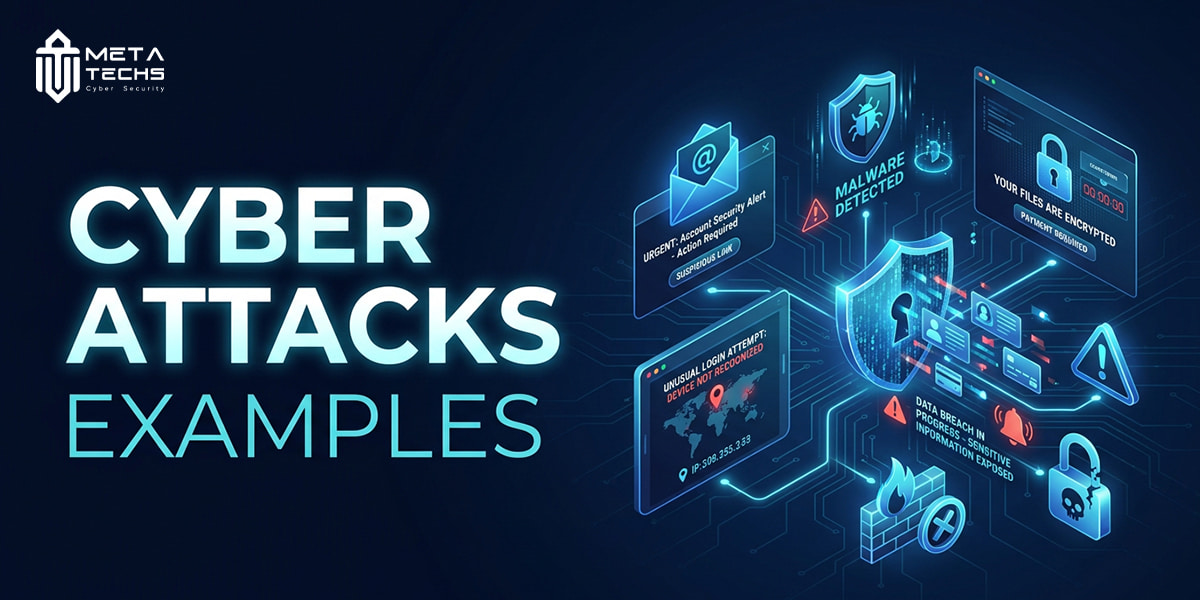
Cyber attacks are becoming more common, and no business is completely immune. From ransomware incidents and data breaches to supply chain compromises, cybercriminals continue to target organizations of all sizes.
Looking at real cyber attacks examples helps businesses understand how these incidents happen, the impact they can have, and the lessons that can be learned from them. In many cases, a single overlooked vulnerability or stolen credential was enough to cause major operational and financial damage.
In this guide, we’ll explore some well-known cyber attack examples and the key cybersecurity lessons organizations can apply to strengthen their defenses.
What Are Cyber Attacks?
Cyber attacks are deliberate attempts to gain unauthorized access to systems, steal data, disrupt operations, or demand money from organizations. While large-scale attacks often make headlines, businesses of all sizes can become targets. In many cases, attackers are not looking for a specific company. They are looking for weak security controls that can be exploited.
Over the last few years, cyber attacks have become more frequent and more expensive. Organizations now rely heavily on cloud platforms, connected devices, remote work environments, and third-party vendors. While these technologies improve efficiency, they also create new opportunities for attackers.
For businesses in the UAE, the risks are growing alongside digital transformation initiatives. Industries such as banking, healthcare, government, retail, and logistics are handling larger volumes of sensitive data than ever before. A single security incident can lead to operational disruption, financial losses, regulatory concerns, and long-term reputational damage.
Why Businesses Should Learn From Real Cyber Attack Examples
Reading about real cyber attack examples provides valuable insight into how incidents actually happen. Many organizations assume cyber attacks involve highly sophisticated techniques, but the reality is often different.
Several major breaches started with simple mistakes. An employee clicked a phishing email. A critical software update was missed. Access permissions were not reviewed. In some cases, a third-party supplier became the entry point.
By studying real-world incidents, businesses can better understand where weaknesses exist and what steps can reduce risk before an attack occurs.
The table below highlights some common types of cyber attacks and well-known examples associated with them.
Attack types covered in this guide: Ransomware (WannaCry), Data Breach (Equifax), Supply Chain Attack (SolarWinds), Social Engineering (Twitter Account Hack), Critical Infrastructure Attack (Colonial Pipeline).
Overview of Cyber Attacks
Cyber attacks can take many forms, but most share a common goal: gaining access to valuable information or disrupting normal business operations. Ransomware attacks encrypt systems and demand payment for recovery. Data breaches expose customer, employee, or financial information. Supply chain attacks target trusted software providers or vendors to reach larger organizations. Social engineering attacks manipulate people into revealing credentials or sensitive information.
What makes these incidents important is not only the technical damage they cause but also their business impact. Some attacks have shut down hospitals, interrupted fuel distribution, exposed millions of customer records, and caused billions of dollars in losses worldwide. Recent incidents continue to show that no sector is immune.
Understanding how these attacks occur is the first step toward building stronger defenses. The following real cyber attack examples demonstrate how attackers operate, what went wrong, and what businesses can learn from these incidents.
Real Cyber Attack Examples and What Businesses Can Learn
Looking at real incidents often tells a much better story than reading cybersecurity definitions. Many of the world’s biggest cyber attacks started with issues that seemed small at the time, an unpatched system, a stolen password, or a trusted software supplier that was compromised.
Here are some of the most well-known cyber attack examples and the lessons businesses can take from them.
WannaCry Ransomware Attack (2017)
The WannaCry ransomware attack spread across more than 150 countries and affected hundreds of thousands of computers within a matter of days. One of the hardest-hit organizations was the UK’s National Health Service (NHS), where hospitals experienced major disruptions and appointments had to be canceled.
The attackers exploited a known Windows vulnerability that many organizations had not yet patched.
Key lesson: Regular software updates and patch management are critical. Delaying security updates can leave organizations exposed to attacks that are already well understood by cybercriminals.
Equifax Data Breach (2017)
Equifax, one of the world’s largest credit reporting agencies, suffered a breach that exposed the personal information of approximately 147 million people. The stolen data included names, addresses, and other highly sensitive information.
Investigations later revealed that attackers gained access through a vulnerability that had already been identified and patched by the software vendor. Key lesson: Knowing about a vulnerability is not enough. Organizations need a structured process for identifying, prioritizing, and applying security updates before attackers exploit them. Vulnerability scanning provides a practical framework for this.
SolarWinds Supply Chain Attack (2020)
The SolarWinds incident became one of the most significant supply chain attacks ever discovered. Attackers compromised software updates distributed by SolarWinds, allowing malicious code to reach thousands of customers, including government agencies and major enterprises.
Many affected organizations were not directly targeted. They were impacted because they trusted a software supplier that had been compromised.
Key lesson: Third-party security matters. Businesses should regularly assess vendors, suppliers, and technology partners rather than focusing only on their own internal systems.
Colonial Pipeline Attack (2021)
Colonial Pipeline operates one of the largest fuel pipeline networks in the United States. A ransomware attack forced the company to shut down operations temporarily, causing fuel shortages and public concern across several states.
Reports suggested the attackers gained access using compromised credentials linked to a remote access account.
Key lesson: Strong passwords and multi-factor authentication (MFA) can prevent many attacks. Remote access systems should always be protected with additional security controls. See our guide on penetration testing to understand how these weaknesses are identified before attackers find them.
Change Healthcare Attack (2024)
One of the most disruptive healthcare cyber incidents in recent years affected Change Healthcare. Attackers gained access using stolen credentials and deployed ransomware that disrupted healthcare billing and payment systems across the United States. The impact extended far beyond a single company and affected healthcare providers nationwide.
Key lesson: Cyber attacks often have supply chain effects. A single security weakness can impact customers, partners, and entire industries.
Related reading
→ DoppelPaymer Ransomware: A Dangerous Threat You Can’t Ignore
→ Learning From the Cisco Data Breach
→ Casio Hacked: A Case Study in Evolving Cyber Threats
What These Attacks Have in Common
Although these incidents happened in different industries and different years, several common themes appear again and again:
- Unpatched vulnerabilities
- Weak access controls
- Stolen credentials
- Third-party security weaknesses
- Lack of visibility into suspicious activity
Most successful attacks do not begin with highly advanced techniques. They often succeed because basic security practices were overlooked.
For businesses, the takeaway is simple. Investing in preventive security measures is usually far less expensive than dealing with the consequences of a breach. Understanding these real cyber attack examples helps organizations identify risks early and strengthen their defenses before attackers have an opportunity to exploit them.
Business Impact of Cyber Attacks
When people hear about cyber attacks, they often focus on the technical side of the incident. In reality, the biggest damage is usually felt across the business itself.
A successful attack can bring operations to a halt. Employees may lose access to critical systems, customers may be unable to use services, and important business processes can be disrupted for days or even weeks.
Financial losses are another major concern. Businesses may face recovery costs, regulatory penalties, legal expenses, and lost revenue during periods of downtime. For some organizations, the reputational damage can last far longer than the technical recovery.
Customer trust is often one of the hardest things to rebuild. When sensitive information is exposed, customers naturally question whether their data is being handled securely. In competitive industries, that loss of confidence can directly impact future business opportunities.
As cyber threats continue to evolve, organizations are realizing that cybersecurity is not just an IT issue. It is a business risk that requires ongoing attention.
Lessons Learned From Real Cyber Attack Examples
Although every incident is different, the same lessons appear repeatedly across many major cyber attacks.
Some of the most important takeaways include:
- Keep systems and software updated.
- Enable multi-factor authentication wherever possible.
- Review user access regularly and remove unnecessary permissions.
- Monitor networks and systems for unusual activity.
- Assess third-party vendors and suppliers carefully.
- Train employees to recognize phishing and social engineering attacks.
- Test incident response and recovery plans before an emergency occurs.
Many organizations affected by major breaches already had security controls in place. The difference often comes down to visibility, preparation, and how quickly risks are identified.
How Meta Techs Helps Prevent Similar Attacks
Preventing cyber attacks requires more than a single security tool. Organizations need a combination of visibility, testing, monitoring, and risk management.
Meta Techs helps businesses strengthen their cybersecurity posture through:
- Vulnerability Assessments
- Penetration Testing
- Security Risk Assessments
- Security Monitoring and Threat Detection
- Cloud Security Reviews
- Compliance and Governance Support — including ISO 27001 and NESA
- Incident Response Readiness Assessments
By identifying weaknesses before attackers do, organizations can reduce risk and improve their ability to respond to emerging threats.
Conclusion
Real cyber attack examples show that no organization is completely immune to cyber threats. From ransomware and data breaches to supply chain attacks, even well-resourced companies can become victims when security gaps go unnoticed.
The good news is that many of these incidents share common warning signs. Learning from past attacks allows organizations to strengthen defenses, improve security practices, and reduce the likelihood of becoming the next headline.
FAQs
What are the 10 most common cyber attacks?
Some of the most common cyber attacks include ransomware, phishing, malware, data breaches, DDoS attacks, insider threats, credential theft, supply chain attacks, social engineering attacks, and business email compromise.
What is the most famous cyber attack?
The WannaCry ransomware attack is often considered one of the most famous cyber attacks because it spread globally and disrupted organizations across more than 150 countries.
How do cyber attacks affect businesses?
Cyber attacks can lead to financial losses, operational downtime, regulatory penalties, reputational damage, and loss of customer trust.
What is ransomware?
Ransomware is a type of malware that encrypts files or systems and demands payment in exchange for restoring access.
How can organizations prevent cyber attacks?
Organizations can reduce risk through regular security assessments, vulnerability management, employee training, multi-factor authentication, continuous monitoring, and incident response planning.
Ready to Strengthen Your Cybersecurity Defenses? Every major cyber attack starts with a weakness that goes unnoticed. Identifying those gaps early can help prevent costly disruptions, data breaches, and reputational damage. Meta Techs helps organizations strengthen their security posture through vulnerability assessments, penetration testing, security monitoring, and risk management services. Contact our cybersecurity experts today to discuss how we can help protect your business from evolving cyber threats.
Related posts:
 What Are Ransomware Attacks ? Ransomware Attack Examples
 Types of Malware Attacks: A Complete Guide for Businesses
 How to Prevent Cyber Attacks on Your Business
 Vercel Security: Lessons from the 2026 Breach
 The ONNX Case and Rise Of Cybersecurity Supply Chain Attacks
 Types of Cyber Attacks: Common Threats Every Business Should Know