Cyber attacks have become a growing concern for businesses of every size. What was once considered a problem for large corporations now affects small businesses, healthcare providers, retailers, financial firms, and government organizations. As companies across the UAE continue to adopt cloud services, remote work, and digital technologies, understanding how to prevent cyber attacks has become more important than ever.
A single security incident can interrupt operations, expose sensitive information, and damage customer trust. For many businesses, cybersecurity is no longer only an IT responsibility. It directly affects business continuity, reputation, and long-term growth.
Why Prevention Is Critical
Many organizations only think about cybersecurity after an incident happens. Unfortunately, by that stage, the damage may already be done.
Cyber attacks can lead to financial losses, operational downtime, and expensive recovery efforts. In some cases, businesses may lose access to critical systems for several days. Customer information can also be exposed, creating legal and reputational challenges.
For companies operating in Dubai and across the UAE, maintaining customer trust is especially important. Clients expect businesses to protect their personal information, financial records, and sensitive business data. A breach can quickly damage relationships that have taken years to build.
Strong cyber attack prevention measures help organizations reduce risks before they become serious problems. Prevention is often far less expensive than recovering from an attack.
Not sure where your business stands today? Get a vulnerability assessment
Common Causes of Cyber Attacks
Many cyber incidents happen because of simple security gaps rather than highly advanced hacking techniques.
Human errors remain one of the biggest causes. Employees may click suspicious links, open malicious attachments, or share sensitive information without realizing the risk.
Weak passwords also continue to create problems. Reusing passwords or using simple credentials makes it easier for attackers to gain unauthorized access.
Phishing emails are another common threat. Attackers often impersonate trusted organizations, delivery companies, banks, or internal employees to trick users into revealing information. This is a form of social engineering that targets people rather than systems.
Outdated software can expose businesses to known vulnerabilities. When systems are not updated regularly, attackers may exploit security flaws that already have available fixes. Consistent patch management helps close this gap before attackers find it.
Third-party vendors and suppliers can also introduce risks. If a partner experiences a security incident, connected businesses may also be affected. This is the same risk pattern seen in major supply chain attacks.
Understanding these risks is an important step in learning how to prevent cyber attacks within your organization. Security is not built around a single tool or product. It requires a combination of technology, employee awareness, and ongoing monitoring.
Related reading
What is Social Engineering in Cyber Security?
Cybersecurity Supply Chain Attacks
Patch Management Process Explained
Security Best Practices to Prevent Cyber Attacks
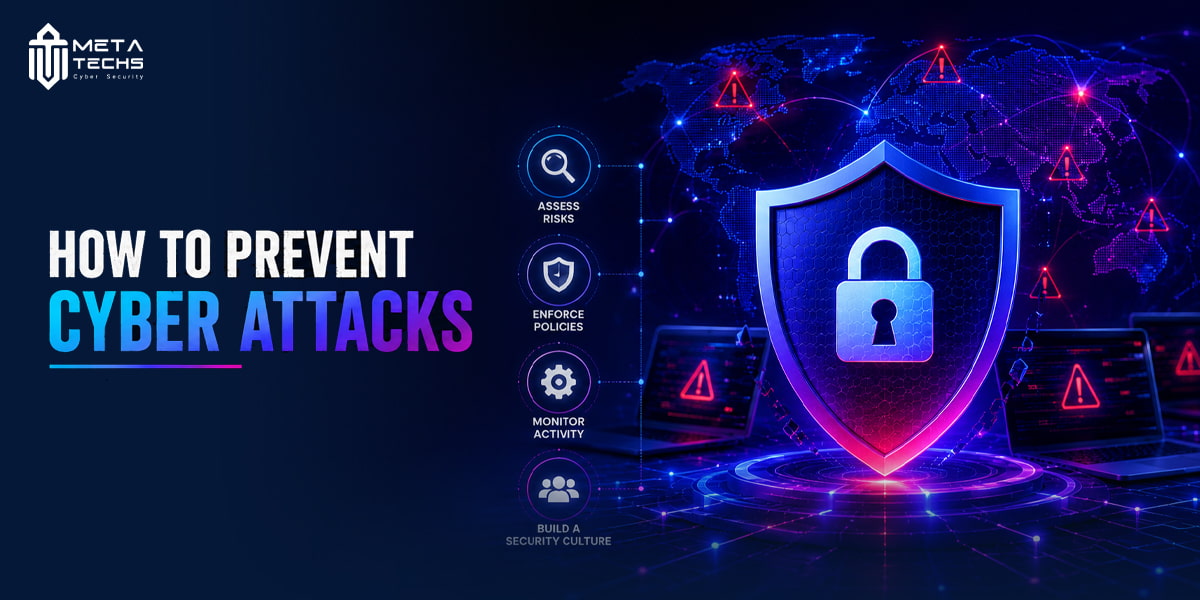
There is no single solution that can stop every cyber threat. Businesses usually reduce risk by combining multiple security measures. The goal is to make it harder for attackers to gain access and easier to detect suspicious activity before damage occurs.
Some of the most effective security practices include:
- Enable multi-factor authentication (MFA): Even if passwords are stolen, attackers still need an additional verification step to access accounts.
- Use strong passwords: Employees should avoid using simple passwords or reusing the same credentials across multiple systems.
- Install updates regularly: Software vendors release security patches to fix vulnerabilities. Delaying updates gives attackers more opportunities to exploit known weaknesses.
- Create regular backups: Backups help organizations recover quickly after ransomware attacks, hardware failures, or accidental data loss.
- Apply least privilege access: Employees should only have access to the systems and information required for their jobs.
These simple steps may seem basic, but they play an important role in how to prevent cyber attacks and reduce security risks.
Employee Awareness Matters
Technology alone cannot stop every attack. Employees often become the first target because attackers know that people can make mistakes.
Regular security training helps employees:
- Recognize phishing emails.
- Verify suspicious requests.
- Report unusual activity quickly.
- Avoid unsafe downloads or links.
- Handle sensitive information securely.
Organizations that invest in employee awareness programs often experience fewer successful attacks. In many cases, teaching employees how to identify threats can prevent incidents before they affect the business.
Building a culture of security also encourages staff to ask questions and report concerns without fear of making mistakes.
Want your team to recognize threats before they happen? Explore employee awareness training
Tools and Technologies That Improve Protection
Security tools provide additional layers of defense and help businesses detect threats earlier.
Firewalls remain one of the first lines of defense for business networks. They help filter incoming traffic and block suspicious connections. Solutions such as Fortinet firewalls are widely used by businesses in the UAE for this purpose.
Endpoint Detection and Response (EDR) solutions provide visibility into laptops, servers, and other devices. These tools can identify unusual behavior before it spreads throughout the network. See our overview of the best EDR software for businesses evaluating these options.
Security monitoring platforms such as SIEM solutions collect and analyze security events, helping organizations detect threats more quickly.
As cyber threats continue to evolve, businesses should regularly review their security controls and technologies. Learning how to prevent cyber attacks requires ongoing attention rather than a one-time investment.
Strong security practices, employee awareness, and the right technologies work together to support long-term cyber attack prevention and help businesses reduce risk over time.
Related reading
Best EDR Software for Businesses
How Meta Techs Helps You Stay Protected
Cybersecurity is not only about buying security tools. Businesses also need to understand where their risks exist and how those risks can affect operations.
Meta Techs helps organizations improve their security posture through practical services designed to identify vulnerabilities and strengthen defenses.
Some of the services include:
- Vulnerability Assessments to identify security weaknesses across systems, applications, and networks.
- Penetration Testing to simulate real-world attacks and evaluate existing security controls.
- Security Monitoring to detect suspicious activity and respond to threats more quickly.
- Incident Response Support to help organizations prepare for and manage security incidents.
- Employee Awareness Training to reduce risks caused by phishing, social engineering, and human error.
As businesses continue to adopt cloud services and remote work environments, understanding how to prevent cyber attacks requires a combination of technology, processes, and employee awareness.
See how these services fit your business. View our cybersecurity solutions
Why Cybersecurity Matters for UAE Businesses
The UAE continues to invest heavily in digital transformation. Businesses are moving applications to the cloud, expanding online services, and adopting new technologies to improve operations.
While these changes create opportunities, they also increase cyber risks.
Customer trust has become a major factor for businesses operating in Dubai and across the UAE. Clients expect organizations to protect their personal information, financial records, and sensitive business data.
Data protection and regulatory requirements are also becoming more important. The UAE Personal Data Protection Law means organizations must demonstrate that they are taking reasonable steps to protect their systems and information.
At the same time, cyber threats continue to grow. Phishing attacks, ransomware, and credential theft remain some of the most common threats affecting businesses today.
Understanding how to prevent cyber attacks is no longer just an IT responsibility. It has become an important part of business continuity, risk management, and long-term growth.
Conclusion
Cyber attacks continue to evolve, but many successful incidents still happen because of weak passwords, phishing emails, outdated software, or a lack of security awareness.
Businesses that invest in employee training, strong security controls, regular assessments, and continuous monitoring are often better prepared to prevent incidents and recover more quickly when problems occur.
Learning how to prevent cyber attacks is an ongoing process. As threats change, businesses must continue reviewing their security practices and improving their defenses.
Ready to Strengthen Your Cybersecurity Defenses?
Concerned about the growing cyber threats affecting businesses today? Meta Techs helps organizations across the UAE identify security gaps, reduce cyber risks, and strengthen their defenses through assessments, testing, and practical cybersecurity solutions.
Contact our cybersecurity team to discuss your security requirements and build a stronger security strategy for your business.
FAQs
What are the most effective ways to prevent cyber attacks?
Multi-factor authentication, employee training, regular software updates, strong passwords, and security assessments are some of the most effective ways to reduce cyber risks.
Why is employee awareness important for cybersecurity?
Many attacks begin with phishing emails or social engineering attempts. Employee awareness helps organizations identify and stop threats before they cause damage.
What cybersecurity tools should businesses use?
Businesses commonly use firewalls, antivirus software, endpoint protection, SIEM platforms, and multi-factor authentication to improve security.
How often should companies conduct security assessments?
Most organizations should perform security assessments annually, while high-risk industries may require more frequent reviews.
Why does cybersecurity matter for businesses in the UAE?
As digital adoption continues to grow across the UAE, businesses face increasing cyber risks, data protection requirements, and customer expectations regarding security.
Related posts:
 Types of Cyber Attacks: Common Threats Every Business Should Know
 Cyber Security Best Practices for Small Business: A Practical Checklist
 Cyber Attacks Examples: Real Incidents and Lessons for Businesses
 know the most common cyber security attacks
 Types of Malware Attacks: A Complete Guide for Businesses
 Data Security for Small Business in Dubai (Complete Guide)