A cybersecurity incident rarely happens at a convenient time. A suspicious login may appear late at night, ransomware may begin encrypting files before the IT team knows what happened, or a compromised account may expose sensitive business data.
The problem is not only the attack itself. During an incident, teams must decide who is responsible, what systems should be isolated, who needs to be informed, and when external help is required.
An incident response plan gives the organization a documented process for making those decisions. A useful plan should not simply describe what an organization intends to do. It should tell people what to do, who makes each decision, and how the business moves from detection to recovery.
Why Every Business Needs an Incident Response Plan
An incident response plan helps businesses respond to cybersecurity incidents in a controlled and consistent way. It defines responsibilities, communication procedures, escalation paths, response actions, and recovery requirements before an incident occurs.
Without a plan, an organization can lose valuable time deciding what to do first. Different teams may also respond differently, which can increase the impact of the incident or make investigation more difficult.
A strong plan should answer practical questions such as:
- Who can officially declare a security incident?
- Who can isolate an affected system?
- Who contacts management, legal teams, customers, or regulators?
- Where does the team communicate if the corporate email system is compromised?
- What evidence needs to be preserved?
- When is a system safe to restore?
For businesses in the UAE, incident response planning also needs to reflect the organization’s regulatory and sector requirements, including the UAE Personal Data Protection Law and NESA requirements. The UAE Cyber Incident Response Plan, updated in July 2026, emphasizes preparation, protection, detection, response, recovery, and continuous learning, along with defined roles and coordination mechanisms.
Related reading
-> Incident Response Services for Businesses
-> Ransomware Protection: How to Defend Your Business
-> UAE Personal Data Protection Law (PDPL)
-> Cyber Attacks Examples: Real Cases and Business Lessons
The 6 Phases of Incident Response (NIST Model)
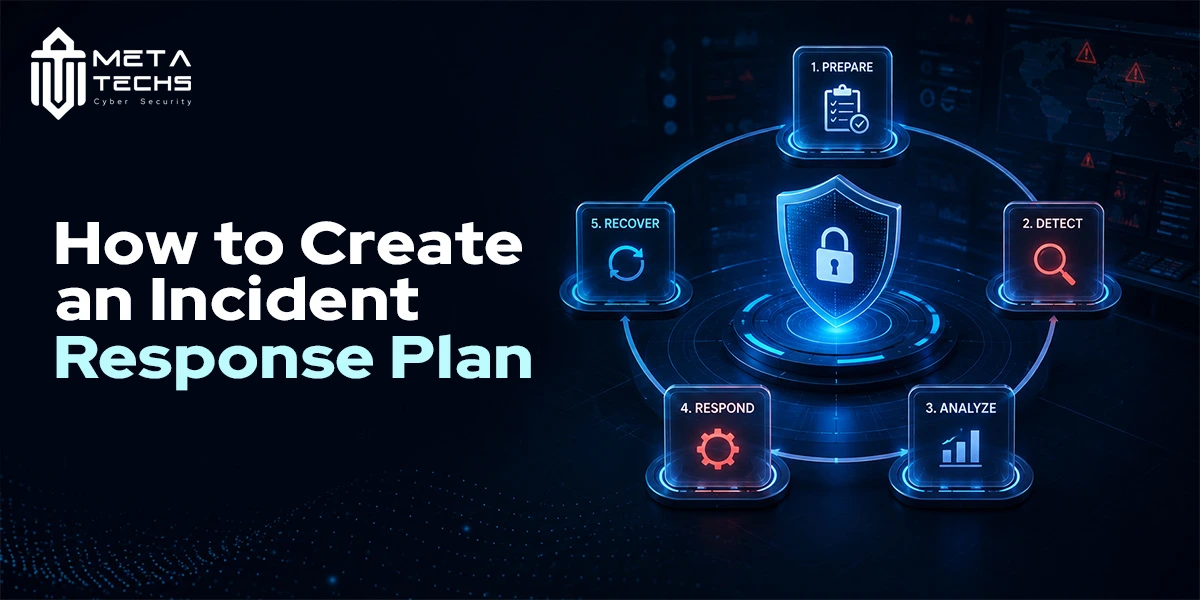
A commonly used incident response process follows six practical stages:
- Preparation: Establish policies, tools, contacts, response teams, communication channels, and employee training before an incident occurs.
- Detection and Analysis: Identify suspicious activity, confirm whether it is an incident, determine its scope, and assess its potential impact. SIEM and EDR tools play a key role in this phase.
- Containment: Limit the spread and impact of the incident. This may involve isolating endpoints, disabling compromised accounts, or restricting network access.
- Eradication: Remove the underlying cause, such as malware, compromised credentials, or an exploited vulnerability.
- Recovery: Restore affected systems and services while confirming that the threat has been addressed.
- Lessons Learned: Document what happened, what worked, what failed, and what needs to change.
There is an important NIST update to understand here. NIST finalized SP 800-61 Revision 3 in April 2025, replacing Revision 2. The current guidance integrates incident response into the NIST Cybersecurity Framework 2.0 rather than treating it as a separate, isolated lifecycle.
The traditional six-phase model is still useful for explaining the operational flow of an incident. However, organizations using current NIST guidance should understand that incident response is connected to broader governance, identification, protection, detection, response, recovery, and continuous improvement activities. This is also the philosophy behind ISO 27001 certification, which treats incident management as part of a continuous security program.
Building Your IR Team and Roles
An incident response team needs more than cybersecurity specialists. A serious incident can involve technical systems, business operations, legal obligations, communications, and customer relationships.
Depending on the organization, an incident response team may include:
- Incident Response Lead: Coordinates the overall response
- Security/IT Team: Investigates and contains technical threats — often supported by a Security Operations Center
- Business Owner: Assesses operational impact
- Legal/Compliance: Handles legal and regulatory considerations, including UAE PDPL obligations
- Communications: Manages internal and external messaging
- Executive Management: Makes major business decisions
- External IR/DFIR Team: Provides specialist investigation and response support via incident response services
The plan should also define decision authority, not just responsibilities. For example, it should identify who can isolate a server, disable a privileged account, approve external forensic support, or authorize system recovery. This reduces confusion when decisions need to be made quickly.
Not sure if your IR team has the right structure and decision authority? Talk to our cyber security consulting team ->
Creating IR Playbooks for Common Scenarios
An incident response plan provides the overall framework. An IR playbook provides more specific instructions for a particular incident type.
Businesses should create playbooks for incidents that are either highly likely or potentially damaging. See our overview of the top cybersecurity threats to understand which scenarios to prioritize. Common examples include:
- Ransomware
- Phishing and business email compromise
- Compromised credentials
- Data breaches
- Malware infections
- DDoS attacks
A useful playbook can follow a simple structure:
Trigger -> First action -> Responsible role -> Containment -> Evidence collection -> Escalation -> Recovery
For example, a ransomware playbook should not simply say “contain the ransomware.” It should identify which team can isolate affected systems, how the incident is escalated, how evidence is preserved, and who decides when restoration can begin.
This is also where an incident response plan template becomes useful. Instead of starting with a blank document, organizations can create sections for contacts, severity levels, roles, communication procedures, incident categories, playbooks, evidence handling, and post-incident review. Our incident response services team can help develop these playbooks to match your actual environment.
Related reading
-> What is Social Engineering in Cyber Security?
-> DLP and Data Leak Prevention
-> Top Cybersecurity Threats Businesses Face Today
-> How to Prevent Cyber Attacks
Testing and Updating Your Plan
An incident response plan that has never been tested may not work when it is needed.
Organizations should regularly test their plans through tabletop exercises, simulations, technical response exercises, and contact verification. Testing should involve more than the security team. IT, management, legal, communications, and business owners may all have responsibilities during a major incident. Penetration testing exercises can also simulate realistic attack scenarios to validate whether the detection and response process actually works.
One useful test is to simulate an incident outside normal working hours. Ask the team: Can we identify the incident, contact the right people, make containment decisions, preserve evidence, and begin recovery without creating the process from scratch?
The plan should also include an alternative communication method if the primary email or collaboration platform is compromised.
After an exercise or real incident, update the plan based on what the organization learned. This is particularly important because technologies, business systems, suppliers, threats, and regulatory requirements change over time. For regulated financial institutions in the UAE, the Central Bank of the UAE requires licensed financial institutions to develop, regularly review, test, and update incident response and recovery plans, including addressing root causes of material incidents. NESA requirements apply similar expectations to other critical-sector organizations.
Has your incident response plan been tested recently? Explore penetration testing and IR readiness assessments
How Meta Techs IR Retainer Services Support Your Plan
An IR retainer does not replace an incident response plan. It provides access to additional expertise and response capacity when an incident exceeds the organization’s internal capabilities.
Meta Techs is recognized among the top IT security companies in Dubai and provides incident response and DFIR services covering incident investigation, digital forensics, malware analysis, ransomware investigation, breach investigation, root cause analysis, threat containment, evidence collection, IR retainer services, and post-incident reporting.
For a business, the combination can be more effective than relying on either option alone: the internal team maintains the response plan and business knowledge, while an external incident response provider can provide specialist support during complex or high-impact incidents. Many organizations also pair IR services with SOC as a Service for continuous monitoring between incidents, and vulnerability scanning to close the gaps that made an incident possible.
Explore our full range of cybersecurity solutions to understand how incident response fits into a broader security program.
Incident Response Plan Readiness Check
A simple way to evaluate an IR plan is to ask these questions:
- Do we know who declares an incident?
- Are response roles and decision authority defined?
- Do we have playbooks for our highest-risk scenarios — including ransomware and phishing?
- Can we communicate if corporate email is compromised?
- Do we know how to preserve evidence?
- Has the plan been tested recently?
- Do we know when to activate external IR support?
If several answers are “No,” the organization may have a policy document, but it may not yet have a response capability that is ready for a real incident. Our cyber security consulting team can help assess readiness and identify the gaps that matter most.
FAQs
What are the 6 phases of incident response?
The commonly used six phases are preparation, detection and analysis, containment, eradication, recovery, and lessons learned. Current NIST SP 800-61 Revision 3 integrates incident response with the broader NIST Cybersecurity Framework 2.0.
How often should an incident response plan be tested?
Organizations should test their incident response plan regularly and update it after significant incidents, exercises, major technology changes, or changes to relevant requirements. Penetration testing and tabletop exercises are both valuable approaches.
Who should be on an incident response team?
An incident response team can include security and IT personnel, an incident response lead, business owners, legal or compliance representatives, communications staff, and executive management. External incident response services may also be involved when additional expertise is required.
What’s the difference between an IR plan and an IR retainer?
An IR plan defines how an organization responds to cybersecurity incidents, including roles, procedures, communication, escalation, and recovery. An IR retainer provides access to an external incident response provider that can assist when specialized expertise or additional response capacity is needed.
Build an Incident Response Plan That Works Under Pressure
A well-documented incident response plan can be the difference between a contained incident and a major breach. Meta Techs helps UAE organizations develop practical IR plans, run tabletop exercises, create playbooks for high-risk scenarios, and access specialist support when incidents escalate beyond internal capacity.
Contact our team today to assess your current IR readiness and build a plan that works when it matters most.
Related posts:
 Incident Response Services for businesses
 Cyber Incident Response: A Strategic Approach to Managing Cyber Threats
 What to Do Immediately After a Ransomware Attack: A Step-by-Step Response Guide
 Managed Detection and Response (MDR) Services: The Complete Guide
 What Is Network Detection and Response
 create a strong password in 5 Steps